Are you trying to make affiliate commissions on social media… but aren’t seeing consistent clicks or sales?
Affiliate marketing on social media sounds simple.
Post content. Drop a link. Make money.
In reality? Most people post randomly, burn out fast, and never see consistent clicks. Forget sales.
It’s not because affiliate marketing doesn’t work.
A report by Luisa Zhou revealed that more than 8 in 10 brands (81%) rely on affiliate programs to improve their business, with 90% of advertisers considering it important to their digital marketing strategy.
The main reason why affiliate marketing on social media is more difficult than it looks is that social media rewards strategy, not effort.
In this guide, I’m going to show you what’s actually working right now, using examples from real creators like:
- Pat Flynn, who sells without sounding salesy using demos and honest drawbacks
- Lucas O’Keefe, who gets around link friction with keyword comments and ManyChat
- Enrico Incarnati, who shows what a simple weekly posting plan looks like in the real world
And more!
Let’s get started:
- How to generate affiliate sales on each social media platform
- How do you choose the best social media platforms for affiliate marketing?
- 7 steps to get started with social media for affiliate marketing
How to generate affiliate sales on each social media platform
Time for some tough love.
There is no “best” platform in general.
Affiliate marketing on social works for you when 3 things line up:
- The platform fits your content style
- The audience already trusts recommendations there
- The algorithm gives your posts a real chance to be seen
Here’s how the top platforms actually perform for affiliates AND when each one makes sense.
Facebook is still one of the most underrated affiliate platforms, especially for trust-based offers.
Why Facebook works for affiliates:
- Strong discussion and comment culture
- Groups create built-in trust and repeat exposure
- Older demographics with higher purchase intent, as evidenced by the fact that users spend an average of $133 on Facebook Marketplace per month
Based on those characteristics, the niches that tend to work well on Facebook tend to solve ongoing or recurring problems (preferably ones constantly being discussed in niche groups) for older or more established audiences.
Examples of niches that fit the bill include personal finance/investing, health and fitness programs, education and courses, and local services.
Now, if you’re trying to sell products bought by Gen-Zers or younger audiences, Facebook might not be the place for you.
Finally, let’s talk numbers. If you start promoting a product on Facebook, a realistic timeline to expect results is as follows:
Creator tips
Since Facebook has a strong discussion and comment culture, the best place to find your ideal customers is within Facebook Groups.
Let’s say you picked health and fitness as the niche of your choice. Next, you need to find a Facebook Group that has 2 key characteristics:
- It’s active. You don’t want to pick up a group only to find that the last post there was made 3 years ago.
- The FB Group needs to have regular discussions where people share questions, doubts, and problems, hoping to find an answer from members. A Group where the members are only posting random stuff or a barrage of links isn’t going to help you.
For instance, GYM RATS is one of the largest public groups on Facebook (with 1.5M members) and has both characteristics.
Next, take a look at the moderator rules. Very carefully.
9 out of 10 times, a group worth joining won’t allow you to post links to products or services that you’re selling.
Even if you do find a group that lets you post links in comments, Amy Starr Allen says that “the majority of the people that do click your link aren’t going to purchase on the spot, and then you don’t have any way to follow up with those people”.
Also, if links are allowed, you’ll likely face significant competition from others posting their links.
The best way to stand out is to focus on providing value first. Look for a post under discussions, something like this:

If you’re a personal trainer, you are PERFECTLY positioned to answer this question.
That’s all you gotta do. Show up under these posts, answer the question, REPEAT. The goal at this stage is to just position yourself as a helpful voice.
Turn the most commonly asked questions into detailed Facebook posts on your personal profile. In the comment section of your personal posts, you can drop the relevant links to recommended products.
Older buyers (55+) pay attention to PROOF. Nearly half trust customer testimonials (49%), and 42% want to see product demos — which is why adding simple demos to your personal profile can actually move them closer to buying.
At the same time, you should try to strike up conversations with the other members of the group in the DMs to best understand where they might be in their journey.
So, when you come across a post like this:
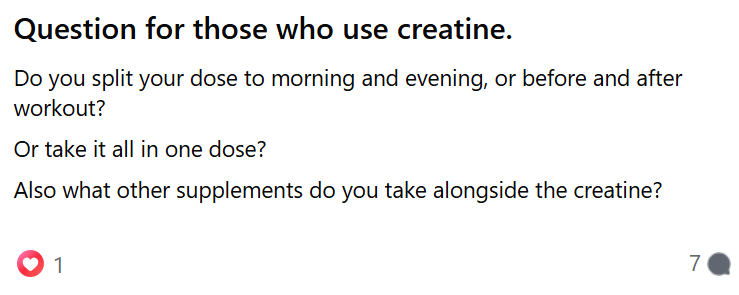
You can give them a short answer in the comments, and possibly redirect them to the more detailed answer on your personal profile, or strike up a conversation in DMs.
Both of those ways allow you to share links with your target audience while establishing trust, and without breaking the Group’s rules.
Facebook rewards participation. If you show up as a helpful voice, not a spammer, it works.
In the United States, 42% of social media users report purchasing at least one product on Instagram.
Instagram is about visibility first, conversions second.
It’s not the easiest platform for direct affiliate clicks, but it’s powerful for warming audiences and driving repeat exposure.
Why Instagram works for affiliates:
- Strong discovery through Reels
- Visual storytelling builds familiarity fast
- High engagement when content feels personal
Based on these characteristics, the niches that work well on IG are typically visual or lifestyle-oriented, where the benefit from transformation can be communicated quickly.
Instagram is great for niches like:
- Fitness/wellness
- Lifestyle and consumer products
- Beauty and fashion
- Personal development
I don’t recommend Instagram for products that require long explanations, such as high-ticket B2B tools.
As far as results go, here’s what you can expect with Instagram:
Creator tips
Let’s take Lucas O’Keefe as an example. His niche is helping other people become profitable creators on Instagram.
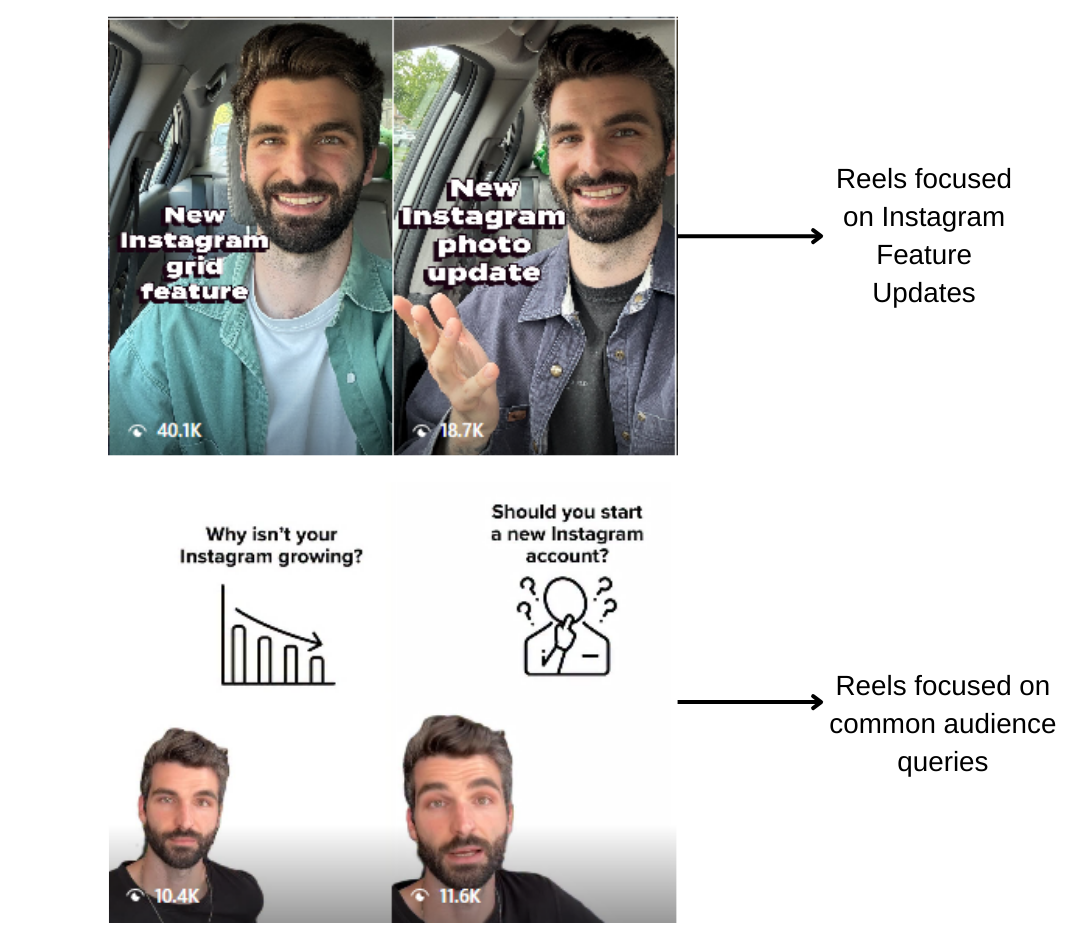
Most of his content focuses on informing you about the latest Instagram features, how to use them to the best of your ability, and workflows to make your life as a creator easier:
Most of his Reels, where he shares recommendations, are “how-to/ how-I” Reels that focus on some of the biggest pain points creators face (content ideas, hooks to go viral, AI tools to scale workflows, etc.):
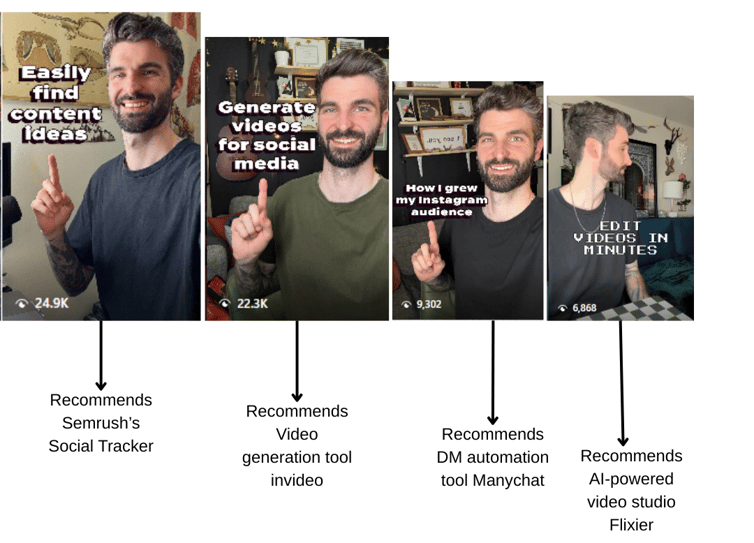
Finally, we get to the recommendation. Since Instagram doesn’t allow you to share clickable links in standard/pinned comments, Lucas just tags the company he’s promoting in the caption. NO LINKS.
Usually, you can drive traffic to your profile, asking people to check out your recommendation through your link-in-bio, which means the least amount of clicks your audience would need to get to the product is 2-3.
To avoid losing sales to that friction, Lucas asks people to respond to the Reel with a specific keyword.
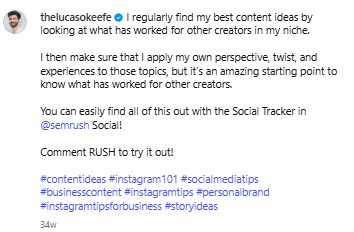
Here’s why this has multiple benefits:
- Self-qualification: People responding with that keyword are letting Lucas know that they’re interested in using the product. Lucas can then use Manychat to set up an automation that DMs those people the link. Since they’ve already qualified themselves, the chances of them buying/trying the product are pretty high.
- Higher reach: Comments are a form of engagement. Comments under Lucas’s Reels signal to the algorithm that people are interested in this, which may push it to more people. It’s a nice growth loop that expands your reach and SALES.
Tiktok
TikTok is the strongest discovery engine for affiliates right now, with 77% of Gen Z users turning to TikTok for product discovery.
Why TikTok works for affiliates:
- Massive organic reach
- Content lives or dies on usefulness, not follower count
- Strong impulse-buy behavior
So, the niches that thrive on TikTok tend to solve a problem quickly, show visible results or transformations, and are easy to understand without context.
Examples of these niches include AI and automation, productivity tools, consumer products, and personal finance/side hustles.
If you plan on promoting niches where results aren’t immediately visible or require trust built over long explanations, such as high-ticket B2B tools, TikTok might not be the platform for you.
As far as numbers go, here’s what you can expect with TikTok:
Creator tips
TikTok Shop is a great place for affiliate marketers selling consumer products for 2 key reasons:
- If you recommend a product on TikTok, people can buy the product directly from TikTok Shop, without ever leaving the platform. This is a great feature for products that people buy on impulse.
- TikTok will also show you everything you need to get started and start earning your first dollar by promoting the best products. It tells you what products are trending, what commissions you earn from selling that product, and how often that product sells.
From a research standpoint, TikTok gives you all the information you need to get started.
All you need to do is create good content that makes people want to buy the product.
You can also see other videos that have promoted that product if you don’t know the type of content that you should post.
According to TikTok Shop Academy, a great vid that has a high chance of landing sales has these qualities:
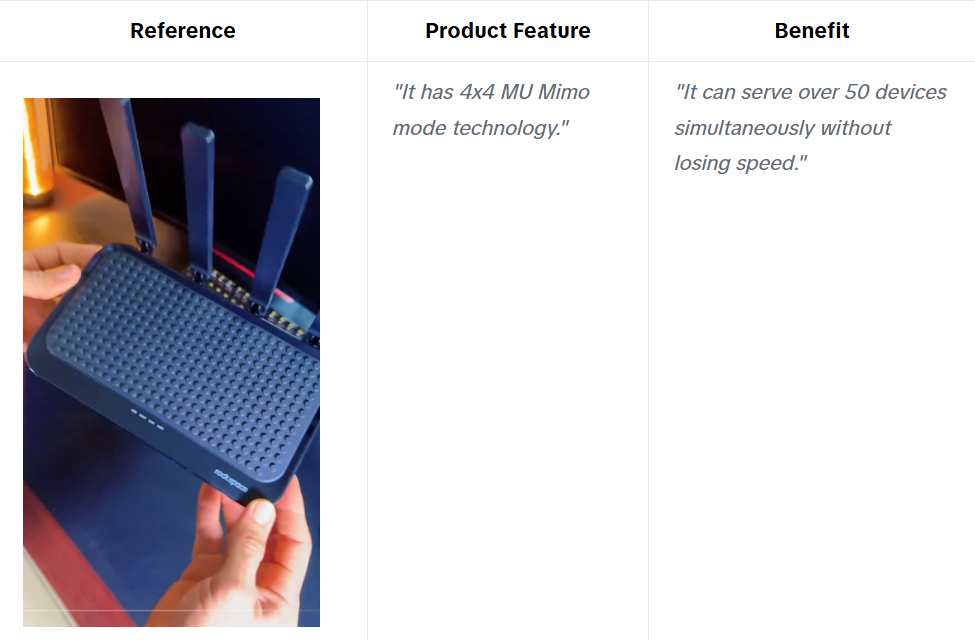
- Includes product features and benefits in detail. Here’s what that would look like if you were promoting a router:
- Include a multi-angle demo. You can grab your audience’s attention by visually showing how the product looks and works in your hands. Use close-up shots to show product details AND long shots to show the entire product.
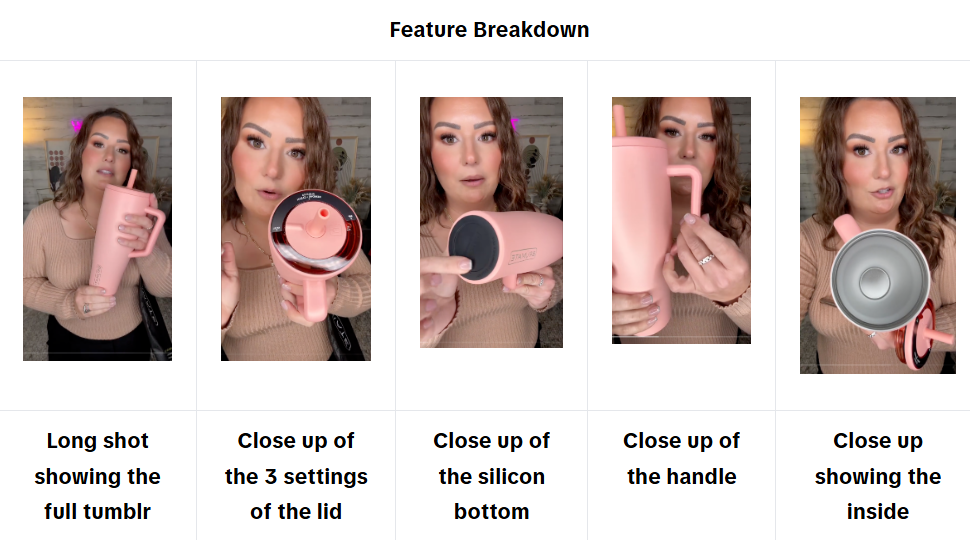
Or show how the product works with a demo and clear before-and-after results:

- Use a strong hook. Eye-catching layover texts or bold statements in the beginning work really well.
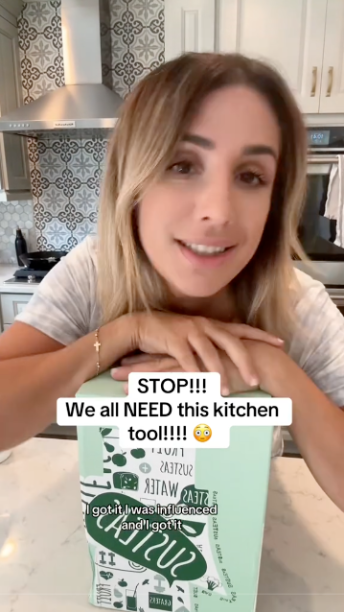
- Include promotions in your CTA (if applicable). If your product has a bundle promotion or free shipping, MENTION IT in your CTA.
- Have fun with it. Unique narration styles, storytelling, role-playing, and skits are all great ways to stop the scroll.
But it’s not all sunshine and rainbows, according to Amy Starr Allen…
The consumer products on TikTok Shop usually give you a $1-$4 commission, which means you’ll probably need to create lots of vids to land a stable income from just promoting them.
Consumer products are generally a one-time buy, so you can’t sit back and expect the money to keep rolling in.
You’ll have to keep up the same high-volume cadence to keep earning the same amount of money.
Youtube
YouTube is the slowest platform to start with and the most powerful long-term.
Why YouTube works for affiliates:
- Viewers spend more time with you, which builds real trust before a click
- Videos keep driving traffic for months or even years after publishing
- Discovery is search-driven, so you reach people actively researching a purchase
The niches that work best on YouTube usually require research before purchase, benefit from walkthroughs or comparisons, and involve higher-ticket decisions.
Think software, education/courses, tech and hardware, B2B tools, and professional services.
If you promote a product in these niches on YouTube, you’re GOLD.
On the flip side, YouTube struggles with trend-driven, fast-moving products and low-ticket impulse buys. If people don’t need to think, compare, or learn, YouTube usually isn’t the move.
As far as results go, here’s what you can expect with YouTube:
Creator tips
Pat Flynn is one of the leading names in affiliate marketing, especially on YouTube. Here are a few of his best tips for standing out (and actually making money) while promoting products:
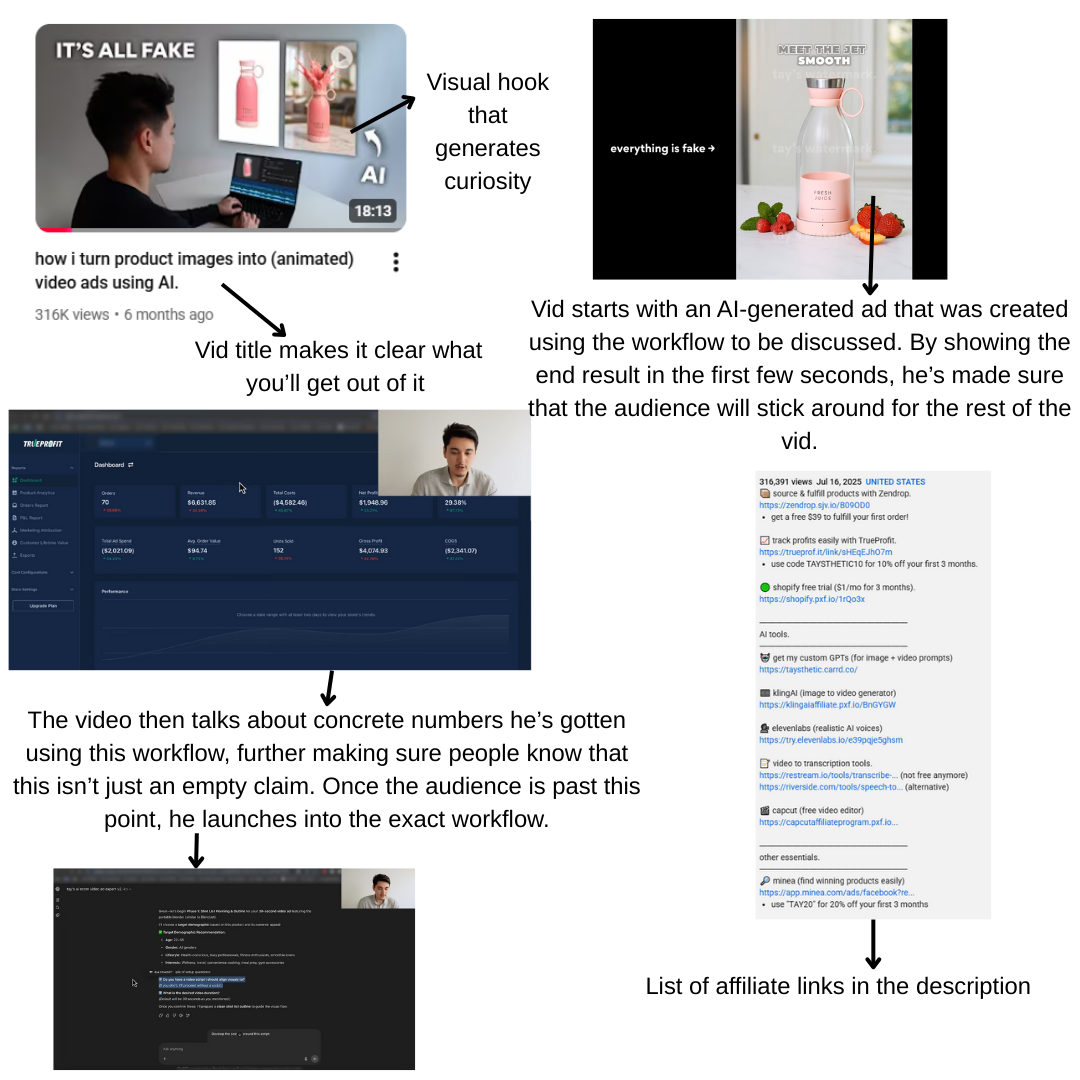
- Make demo videos. Demo videos don’t need to be 45-minute deep dives covering every feature. Instead, show how you personally use the product to solve a real problem. Here’s what a killer demo video should look like:
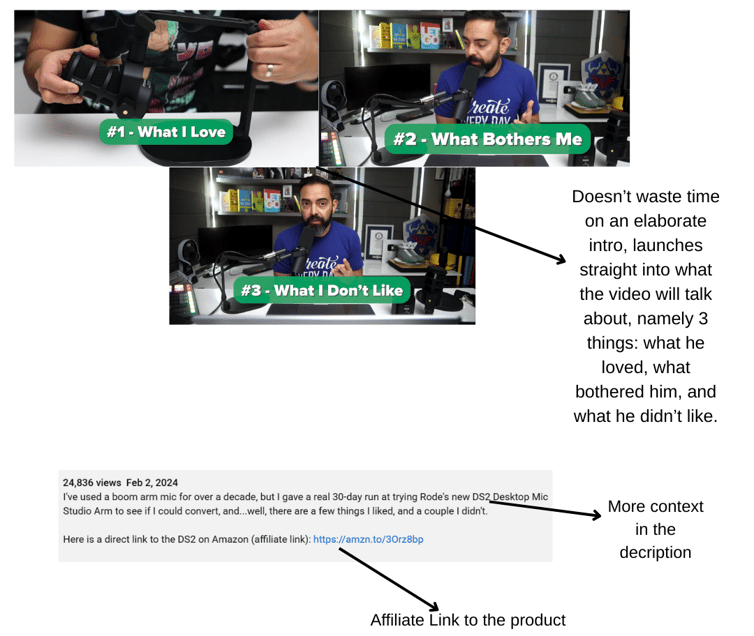
- Be honest about drawbacks: Don’t pretend the product is perfect. Call out 1-2 things you don’t love or explain how you’ve worked around a limitation. This builds credibility fast and makes your recommendation feel more authentic. For example, here’s an honest review of a Desktop Mic Studio Arm by Pat:
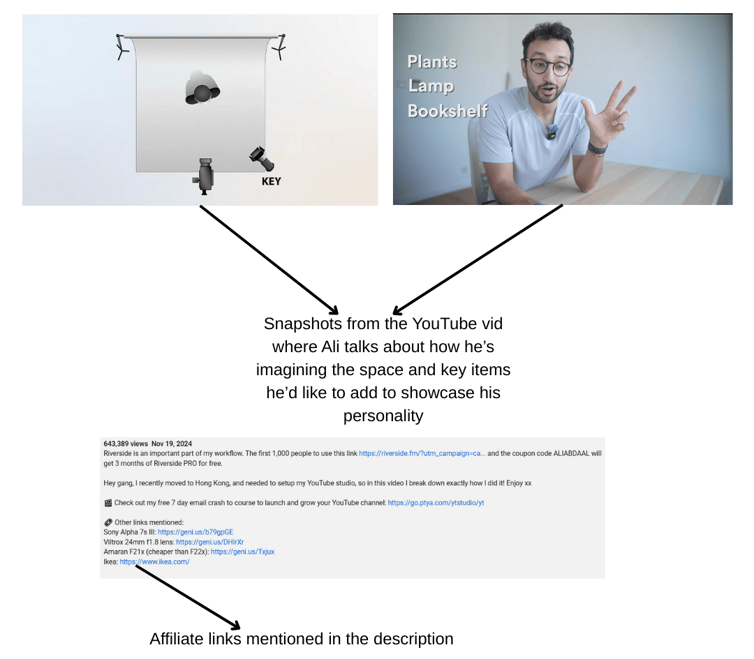
- Match your audience’s language. Pat specifically warns against going too technical if your audience isn’t. Don't say "4.5 cardioid mic shotgun fire with 2.9 extension" when your audience just wants "good podcast mic." For instance, in this vid, Ali Abdaal discusses how he built a YouTube Studio in a small room and the tools he would use for his setup. The language is simple, meant to give a basic understanding of his choices, which is exactly what the audience wanted from that vid.
- Use the “already bought” research hack. Ask your audience, “What was the last thing you bought that was useful related to [your niche]?” Their answers will tell you what they already spend money on, and which brands are perfect for affiliate partnerships.
How do you choose the best social media platforms for affiliates?
This is where most affiliate marketers mess up.
They ask, “Which platform makes the most money?”
The question they REALLY should be asking is: “Which platform gives ME the best chance to be consistent, trusted, and seen?”
Because the best platform is the one you can stick with long enough for momentum to kick in.
To make things simple, I've compiled a list of the top 8 factors to help you choose the right social platform.
Demographics
Start with who you’re selling to.
Ask yourself: Where does my target audience hang out?
If your audience doesn’t hang out on the platform, nothing else matters.
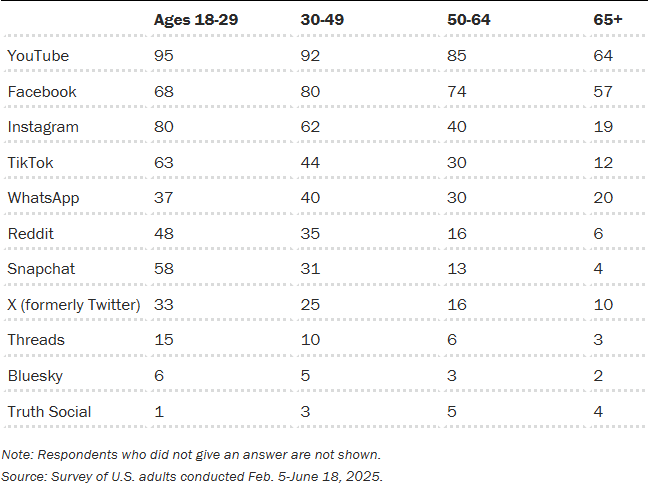
Different platforms skew toward different age groups, income levels, and buying behavior, as shown by this Pew Research report.
Here’s how the usage of social media platforms varies based on age (figures represent % of US adults):
Similarly, here’s what that distribution looks like based on household income:
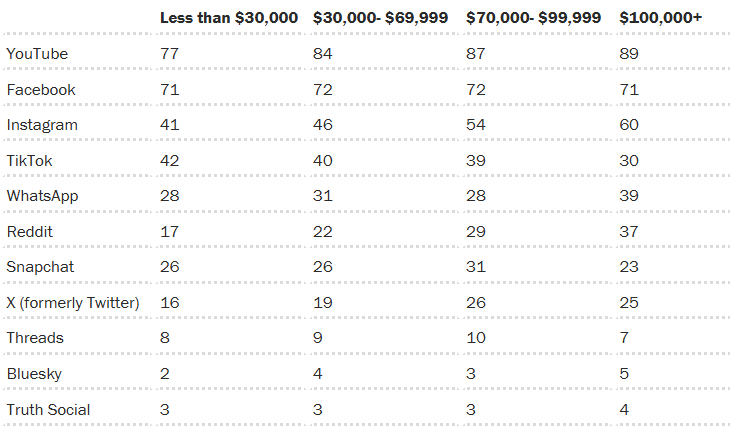
So, let’s say your niche is functional fitness coaching for veterans (50+ years old). You’re more likely to find success on Facebook or YouTube than on TikTok or Instagram.
Simply because that’s where your target audience hangs out.
Trust and purchase intent on the platform
Affiliate links convert when the recommendation feels natural.
Not all platforms are trusted equally when it comes to buying. Some platforms are entertainment-first, like Instagram and TikTok, discovery-first like YouTube, decision-first like Reddit or LinkedIn.
Higher-trust platforms like YouTube usually:
- Reward personal experience posts
- Perform well with comparisons and walkthroughs
- Convert better on higher-ticket offers
Lower-trust platforms like Instagram or TikTok can still work, but they usually need more repetition and warming up.
To understand your target audience’s purchase intent, ask yourself:
- Are they consumers or professionals?
- Are they impulse buyers or research-heavy buyers?
- Do they already follow creators for recommendations?
For example, if you’re a fashion influencer promoting a trendy top, you’re selling a low-ticket, impulse-buy product to consumers. A short, cutesy Reel on Instagram or Facebook can absolutely do the job — especially if your audience already follows other fashion creators and expects recommendations.
But if you’re a B2B creator promoting a CRM, the playbook changes. Professionals want clarity, comparisons, and proof. In that case, a well-structured breakdown or comparison on YouTube or LinkedIn is usually what nudges them toward a decision.
Content style
This is the most underrated factor.
The best platform for affiliate marketing is the one that matches how you naturally create content.
Ask yourself:
- Do I prefer writing or speaking? For writers, the best platforms would be X/Twitter and LinkedIn. If you love speaking, IG/YouTube/TikTok should be your go-to platforms.
- Do I like short-form or long-form? If you like making cool edits/memes/skits, you probably like entertaining folks. I’d recommend IG and TikTok. If you like creating video essays (or written essays), deep breakdowns, and explainers, I’d recommend LinkedIn or YouTube.
- Am I better at teaching, storytelling, or reacting? If you’re a storyteller, take inspiration from Casey Neistat. If you’re a teacher, you could try emulating Alex Hormozi. And these are just on YouTube. You can find similar examples across platforms.
If you hate video, forcing yourself onto video-heavy platforms like TikTok/Instagram/YouTube will burn you out. If you hate writing, text-first platforms like LinkedIn and X will feel like torture.
Match the platform to your strengths.
Organic reach
Organic reach determines how fast you get feedback.
Early wins keep you motivated, so if you’re just starting out, prioritize platforms where your content can still travel without a following, like TikTok or Instagram. The algo on these platforms are built for discovery, so naturally, a vid from an account with 0 followers CAN be pushed to millions based on early, high-engagement signals.
This allows you to test ideas faster, reach new audiences, and reduce dependence on ads early on.
For platforms like TikTok and Instagram, shares and watch time matter MUCH more than follower count.
For instance, here’s a relatively smaller creator (with ~1.3K followers) who talks about videography, photography, and editing, with an average view count of 1.5K:
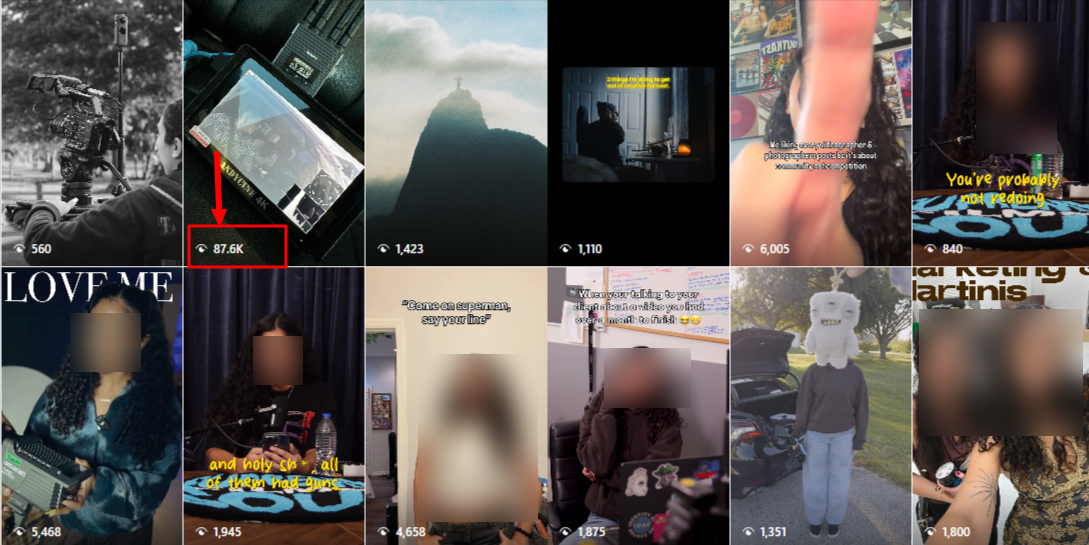
You can immediately see that a recent reel has 87.6K views so far, which is high compared to her average view count.
Longevity and content shelf life
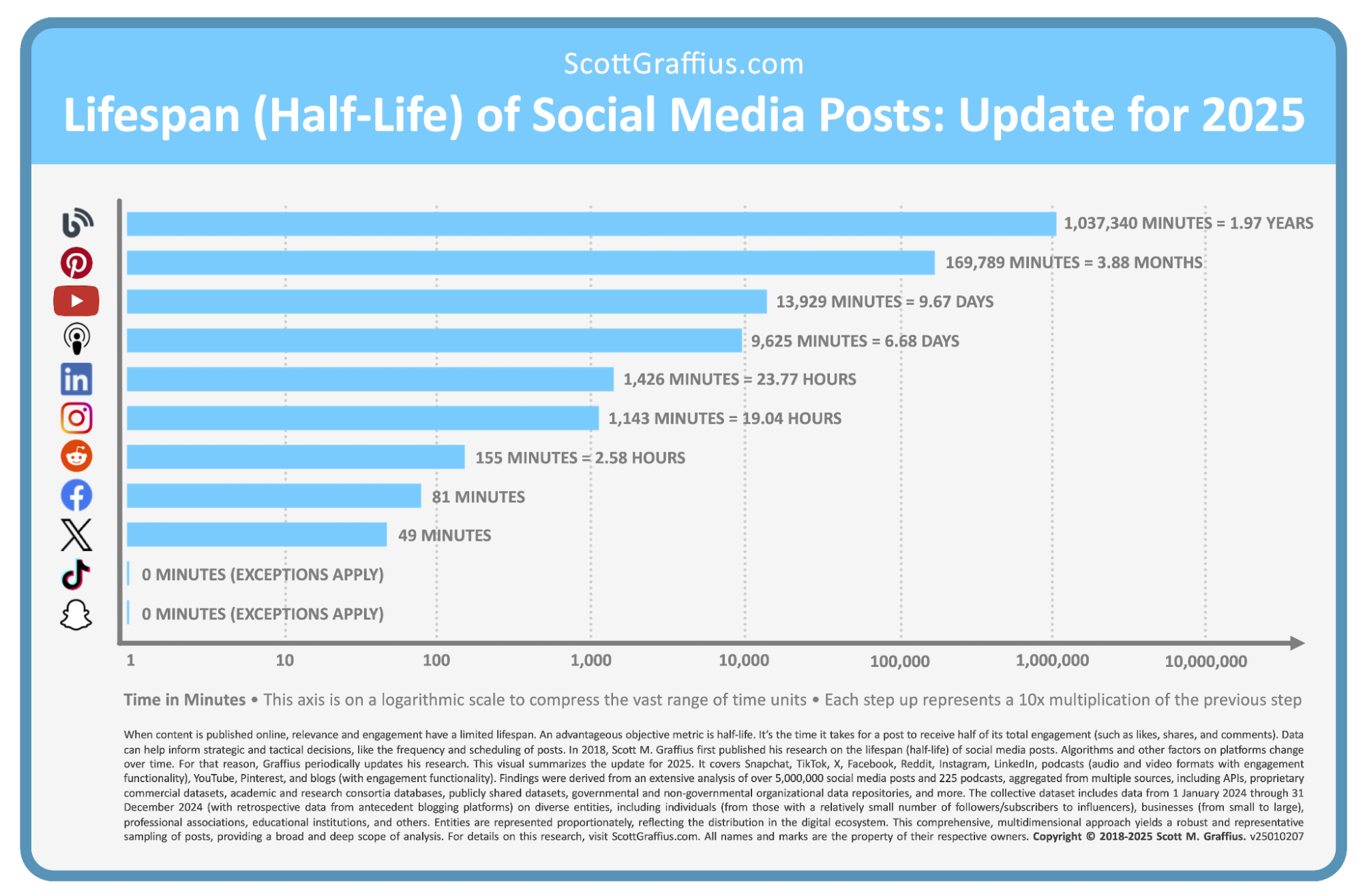
On short shelf-life platforms, you have to post frequently because speed, trends, and freshness are what get rewarded. Miss the wave, and the post is basically gone.
Other platforms can keep your content alive for years.
These longer-shelf-life platforms might keep it alive for years, rewarding tutorials, reviews, and comparisons, and generating passive clicks over time. This is where affiliate marketing really compounds, because your content keeps working even when you’re not.
However, creating content on these platforms can come with slow initial growth.
When I say slow, you could keep making videos for months or years and still have the best video not cross 700 views. This isn’t to scare you, but to show you the tradeoff between the short-shelf and longer-shelf platforms.
Ease of linking
This one is practical AND important, because every extra step reduces risk.
Ask:
- Can I link directly?
- Do links live in posts, comments, bios, or descriptions?
- How many steps does it take to get from content to offer?
Platforms that make linking easier will convert faster, require less explanation, and are more beginner-friendly. For instance, on YouTube, you can just include links in the vid descriptions and mention them in your vid.
However, for Instagram, affiliate links are usually placed on your profile, so you’d have to take the additional action of going from a Reel to the person’s profile. More steps might mean more friction.
Harder-linking platforms can still work, but demand stronger pre-selling, clearer calls to action, and more repetition to get the same result.
Paid ad viability
Even if you’re starting organic, paid ads matter in the long term, cause your best-performing organic posts often become your best ads.
To pinpoint the best platform, ask:
- Does this platform allow affiliate ads?
- Are CPMs reasonable for my niche?
- Can I retarget engaged viewers?
This is what the CPM (cost per 1k views) figures looked like for different social media platforms last year:
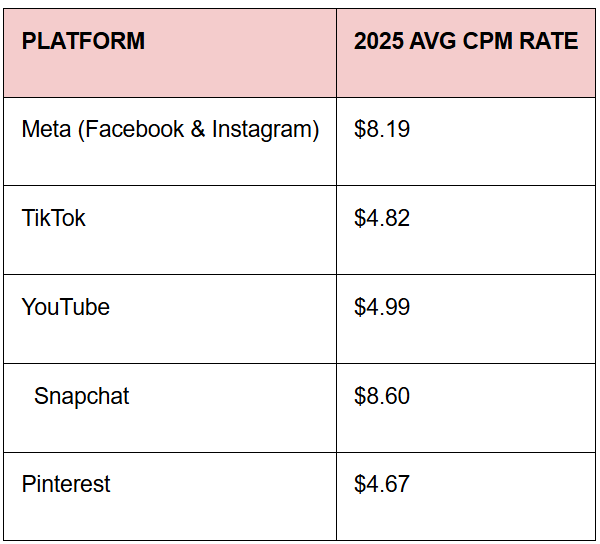
Based on this, Meta platforms (Instagram and Facebook ads) are often a strong option for higher-ticket affiliate offers. Not because CPMs are higher, but because those offers can absorb higher CPMs, and Meta’s targeting and retargeting make conversion math work.
You don’t need to run ads right away. But choosing a platform that supports paid scaling gives you an alternative option when organic plateaus.
The simple decision framework
If you’re stuck, choose the platform where:
- Your audience already buys
- You enjoy creating content
- Organic reach still exists
- Linking isn’t painful
- You can realistically post for 90 days straight
That’s the platform most likely to make you money.
7 steps to get started with social media for affiliate marketing
Most people start affiliate marketing on social like this:
Post a link-> Hope someone clicks-> Get discouraged-> Quit
And then they conclude, “Affiliate marketing doesn’t work.”
FALSE.
What you need to make this work is a system.
Here’s a simple 7-step setup that turns social media into a repeatable affiliate income channel (without being spammy):
Step 1: Pick a niche
If you post about everything, you’ll be trusted for nothing.
The riches are in the “niches.”
Your niche is the filter that makes everything easier:
- What you post
- What you promote
- Who follows you
- Why people trust you
Start by picking up 1 topic you can talk about for the next 90 days.
Done?
Great, now make sure it naturally connects to products people already buy.
Let's say you want to become a fitness influencer. What do people already buy from fitness influencers? Coaching programs? PDFs/digital assets? It’s usually between those two.
Say, you decide to create digital nutrition programs to help people stay lean while gaining muscle. Now, within those programs, you could probably link out to:
- PaleoPlan: Focuses on the paleo diet with weekly meal plans, shopping lists, and 100s of recipes.
- The Vitamin Shoppe: A leading retailer of vitamins and supplements.
- Miracle Noodle: Offers a line of food products to help customers eat healthy.
- Keyto: Breath sensor for ketosis as part of a larger keto weight loss plan, also offers keto recipes, personalized meal plans, etc.
Since you’re selling nutrition programs, these products would naturally fit within the digital assets.
If you can show proof that these products work (probably through before/after framing), you’re set.
Remember: A boring niche that buys is better than a fun niche that doesn’t.
Step 2: Choose a platform
Pick the platform you can consistently create for:
- If you like writing: LinkedIn or X
- If you like talking/teaching: YouTube
- If you like short, punchy video: TikTok or Instagram
- If you like discussions: Facebook Groups or Reddit
Pick ONE platform to start. Cross-posting comes later.
Step 3: Decide what type of affiliate products you’ll promote
Different products require different trust levels.
You can promote:
- Physical products
- Software/tools (SaaS)
- Courses/education
- Services
- Subscriptions
…and the list goes on.
Low-ticket products can convert fast with simple demos. For instance, gimbal stabilizers.
High-ticket products, such as software, require more context, proof, and comparisons.
Let’s go with our fitness influencer example from before. If you have a nutrition program, start by picking 1-3 products.
Say you choose PaleoPlan, Keyto, and The Vitamin Shoppe. Ideally, these are brands/products you already use — or can realistically test.
If you’ve personally used PaleoPlan and Keyto, you can create content around keto and paleo recipes from a nutritional angle. Both brands already publish tons of recipes, so all you’re really doing is following along, documenting the process, and showing the results.
That feels organic because it stays squarely in your niche. It also hits the edutainment sweet spot — recipe-style content is bingeable, especially on video-first platforms.
Step 4: Create a content plan for affiliate posts
This is the part that saves you from “what do I post today?” panic.
What you need is a content plan that gives your audience plenty of reasons to click on your links without forcing it down their throats.
The easiest way to do that is to rotate between a few clear content types so your feed stays balanced.
Here are 4 categories you can cycle through:
- Problem content (what’s frustrating your audience)
- Education content (how to solve it)
- Proof content (results, examples, demos)
- Offer content (the actual recommendation)
When you rotate these, selling feels natural instead of forced.
Pro tip: Use a social media automation tool like Post Planner to automate your posting schedule within those content buckets.
A simple weekly plan might look like this:
- 3 value posts
- 1 proof post
- 1 offer post
Here’s what this looks like in the real world.
Enrico Incarnati is a coach who helps business owners grow and sell using organic content.
Here’s how Enrico incorporates it into his weekly plan (the example is from the content he posted from Dec 3 - Dec 10):
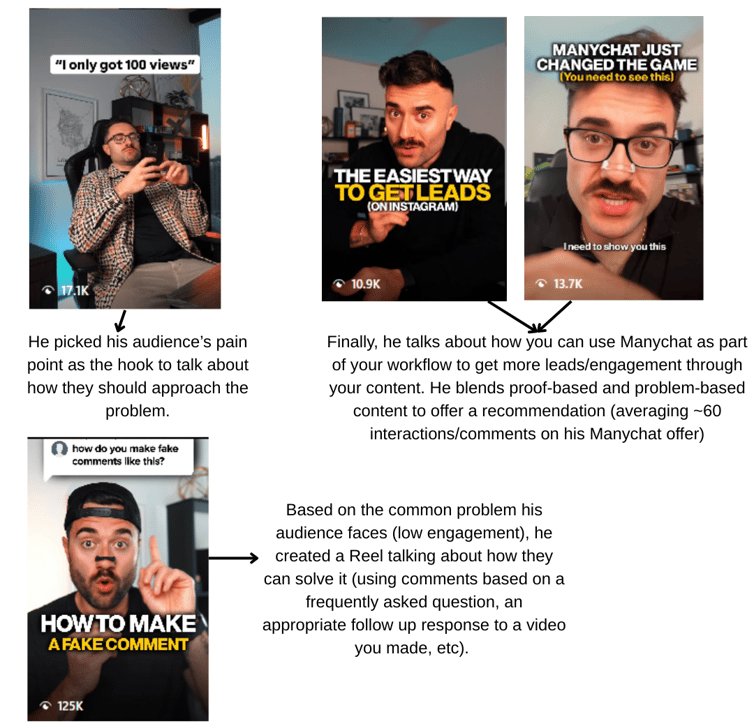
He often uses ManyChat to capture leads or sell digital assets. But notice how it fits into the content instead of dominating it.
Step 5: Build your conversion path
Keep this rule of thumb in mind: Each piece of content should only have one CTA.
If you try sending people to 10 places, they’ll end up overwhelmed and not take action at all.
Pick the cleanest path for the platform:
- Link-in-bio page (best for Instagram/TikTok)
- Pinned comment (great for TikTok/YouTube)
- Story swipe/profile CTA (where available)
Once you’ve decided on your conversion path, you need to bridge your content to your affiliate offer.
Similar to the previous example of Enrico integrating Manychat into his content, you should be posting contextual stuff that talks about:
- Why do you use it
- When it’s useful
- Who it’s not for
Then pre-sell before the click using one of these angles:
- Short personal take (“this is what changed for me”)
- Comparison (“X vs Y, here’s the real difference”)
- Mistake-based framing (“I wasted money on X before finding Y”)
Make sure you can explain why your offer is worth clicking in 1 sentence.
Step 6: Add conversion assets that compound results
Instead of relying on every post to convert, you can add conversion assets that keep working even when a post flops.
Think:
- Email capture (free checklists, “best tools I use,” starter guides, etc.)
- A simple Notion or Google Doc resource hub (“my affiliate stack”)
Here’s how 2 creators use Stan (designed for online creators to sell all of their courses, digital products, memberships, and bookings directly from a single link-in-bio page) for their conversion assets:
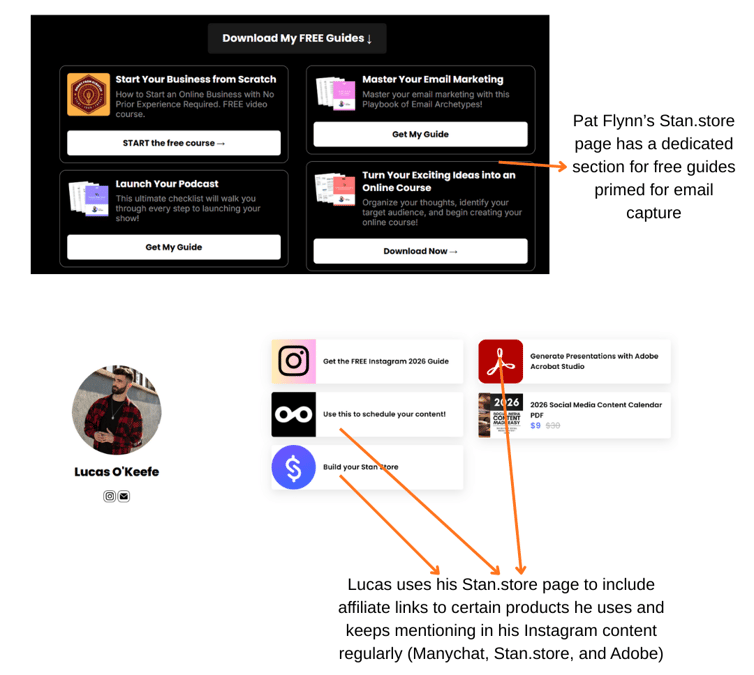
Now, if those links send people to the wrong product page, region, or a dead page, your conversion rate will drop. Drastically.
To maximize the likelihood of conversion, use affiliate link management tools like Geniuslink.
Here’s what a tool like Geniuslink can do for you:
- One link automatically sends visitors to the correct regional storefront (US, UK, Canada, etc.) instead of a generic or wrong store, massively improving international conversions.
- You connect your affiliate IDs once, and Geniuslink ensures every link carries your tracking and earns commissions without manually editing URLs.
- Most of your social traffic clicks from phones. Deep linking pushes them into the shopping app (like Amazon), where conversions are highest.
- Route traffic based on conditions (location, device) or test multiple offers from one link to see what converts best.
- Give your audience multiple retailers to choose from with one link, increasing commissions and reducing lost sales.
- Flag broken links or out-of-stock products so you fix problems before conversions bleed out.
Conversion rates can also take a hit if you try to be too sneaky with your affiliate links.
In other words, if your links and content don’t feel safe, credible, and genuinely helpful, you’ll have a really tough time getting people to click on your links.
Your content should include these trust signals:
- Disclosures (they can increase conversions when done right)
- Proof of use (screenshots, demos, real outcomes)
- Specific details that make it obvious you actually use the thing.
Step 7: Track performance and optimize
Some affiliate marketers obsess over followers. But followers don’t pay commissions.
You get commissions based on the clicks that buy the products you recommend.
To make a stable income from affiliate marketing, you need to understand what behavior correlates with sales.
A great way to understand this is to focus on signals that indicate purchase intent. Some examples include:
- Link clicks → the clearest indicator of earning potential
- Saves & shares → “I might buy this later” behavior
- Watch time (video platforms) → did people stay long enough to trust you?
- Comments → especially questions and objections
- Posts that lead to DMs like: “What tool is that?” or “Link?” → gold-tier buying intent
Once you spot what’s working, turn it into repeatable wins:
- Same hook → new example or use case
- Same product → different pain point or outcome
- Same post → reposted at a better time or platform
- Same content → repackaged as a Reel, Story, or Short
Let’s say you’re posting on Instagram.
Inside Instagram Insights, you can look at things like watch time and retention (for video), saves and shares, profile visits, and replies. These signals tell you which content will be more likely to drive sales.
Next, pair that with a link management tool like Geniuslink so you can see which posts actually turn into sales.
Here’s what a sample workflow could look like:
- Create one Geniuslink link per campaign.
- Within Geniuslink, you can find the total clicks per link, clicks by country, and device type.
- Finally, connect the dots between link data and platform analytics to understand what your next steps should look like:
Use your “winning” posts as a blueprint to create future top-performing posts.
Ready to start driving affiliate sales on social media?
Affiliate marketing on social media usually feels hard because most people don’t have a solid system to fall back on.
They post inconsistently, promote too many things, chase the wrong metrics, and give up before patterns have time to form.
The creators who earn consistently do a few things well:
- They pick a clear niche and stick with it.
- They choose platforms that match how they naturally create.
- They recommend tools they genuinely use.
- They make it easy for interested people to click, trust, and buy.
- They pay attention to signals that indicate buying intent, not vanity.
Using a social media management tool like Post Planner makes automating your planning, content creation, and publishing A LOT easier.
The best part? You can get started for free here. 😉







No Comments