How is your audience finding your content today?
Is it through search? AI? Newsletters?
Or is it through the feeds they scroll multiple times a day?
For most publishers, it’s likely the last one. Social feeds now shape what people see first and which brands they recognize over time.
When readers see your brand reacting to news and showing perspective daily, that exposure compounds into:
- A recognizable point of view
- Trust built through repetition
- Consistent presence in daily conversations
In 2026, the publishers and media companies that’ll lead the pack will:
- Treat feeds like editorial products
- Optimize content for engagement
- Design content based on people’s consumption habits
In this post, I’ll show you how those top publishers and media companies, like The Guardian and The Daily Mail, run their social media strategies.
Feel free to skip ahead:
- 6 steps to build a social media strategy for publishers
- Best social media platforms for publishers to increase audience engagement
- 3 key social media trends for publishers in 2026
- Best social media marketing tips for publishers
6 steps to build a social media strategy for publishers
Most publishers fail on social media because they skip strategy and jump straight to posting.
The first step of building a winning strategy is to define what success actually looks like for your brand.
Step 1: Define what success looks like for your publisher
For publishers, “success” usually falls into a few buckets:
- Audience growth (followers, subscribers, returning readers)
- Engagement (comments, shares, saves, conversations)
- Traffic (clicks to site, newsletters, apps)
- Brand authority (being referenced, quoted, trusted)
- Revenue (subscriptions, sponsorships, events)
Based on your goal, you’ll prioritize different types of content.
For instance, if your goal is engagement, link-heavy posts will underperform. If your goal is traffic, meme-only feeds won’t convert. If your goal is subscriptions, shallow viral content won’t build trust.
Pick a primary goal for the platform of your choice (1-2 secondary goals at max), write them down, and share them with your team internally.
This should be your North Star for at least the next 6 to 12 months.
Pro tip: Don’t get distracted by the “vanity metrics” used by other publishers. For instance, if you’re chasing newsletter sign-ups, an IG Reel with fewer views but more link in bio clicks should be considered more successful than a viral Reel that sent zero traffic to your newsletter.
Step 2: Choose the right platforms for your audience and content
Different platforms reward different behaviors. Some might favor discussion and debate, while others might reward visuals and short-form video.
For instance, DuckDuckGo’s founder recently did an interview with Entrepreneur. While the full interview is available on their YouTube channel (it got 465 views), they also posted a short clip from said interview as an Instagram Reel that got ~21K views.
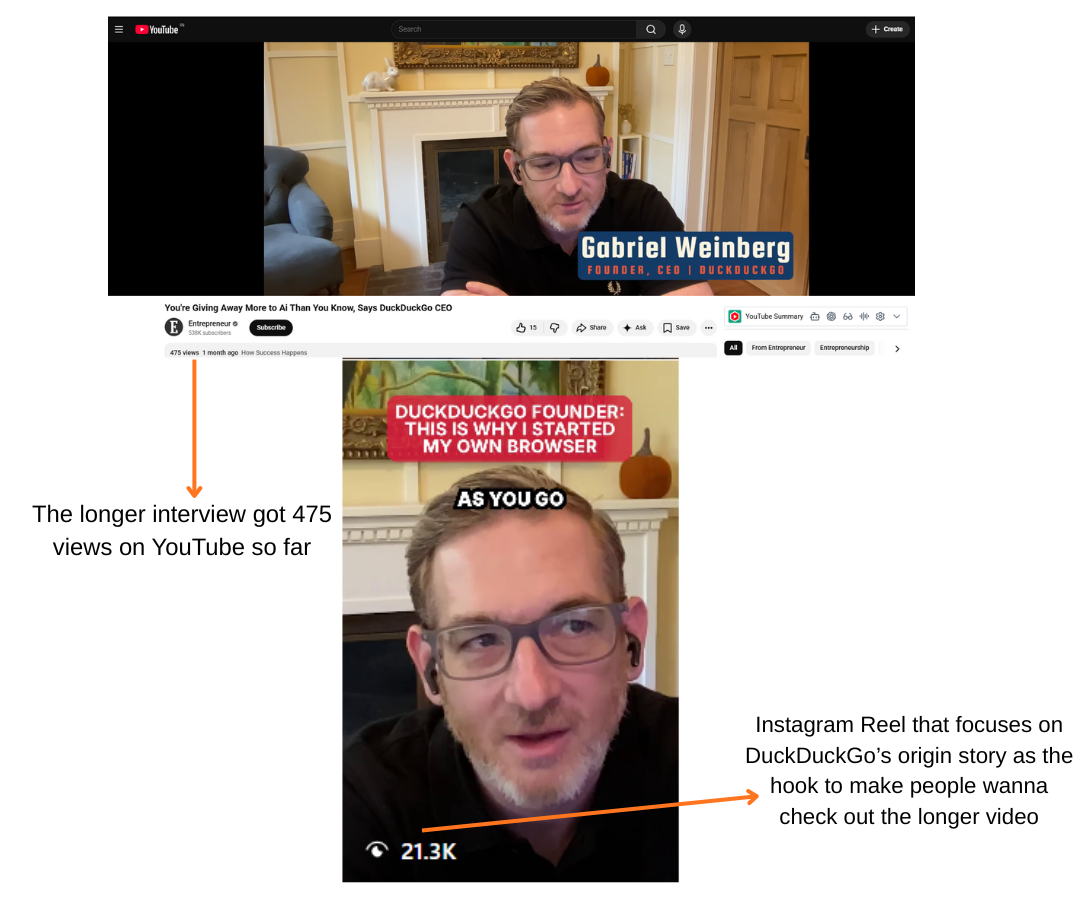 What’s the takeaway here? A scroll-stopping Instagram hook ensured new people could discover the interview.
If they like the topic of discussion, they can tune in to the full vid on YouTube, helping it in the long run.
Start by identifying where your audience already engages and what they love engaging with on that platform. Also consider the type of content usually pushed by that platform. These 3 things are pivotal to setting up a sustainable social media strategy.
At this point, you shouldn’t focus on more than 3 platforms. Master the ones you’ve picked, and later you can think about diversifying your reach.
Step 3: Decide what content you’ll post (and what you won’t)
This is where most publishers accidentally sabotage themselves. They post everything from articles and updates to press releases and interviews.
The best way to treat social feeds as editorial products in their own regard is to have dedicated content buckets (categories).
Common publisher content buckets might include:
- Breaking news / timely updates
- Context and explainers
- Quotes and key takeaways
- Opinion or perspective
- Evergreen content
- Audience prompts and questions
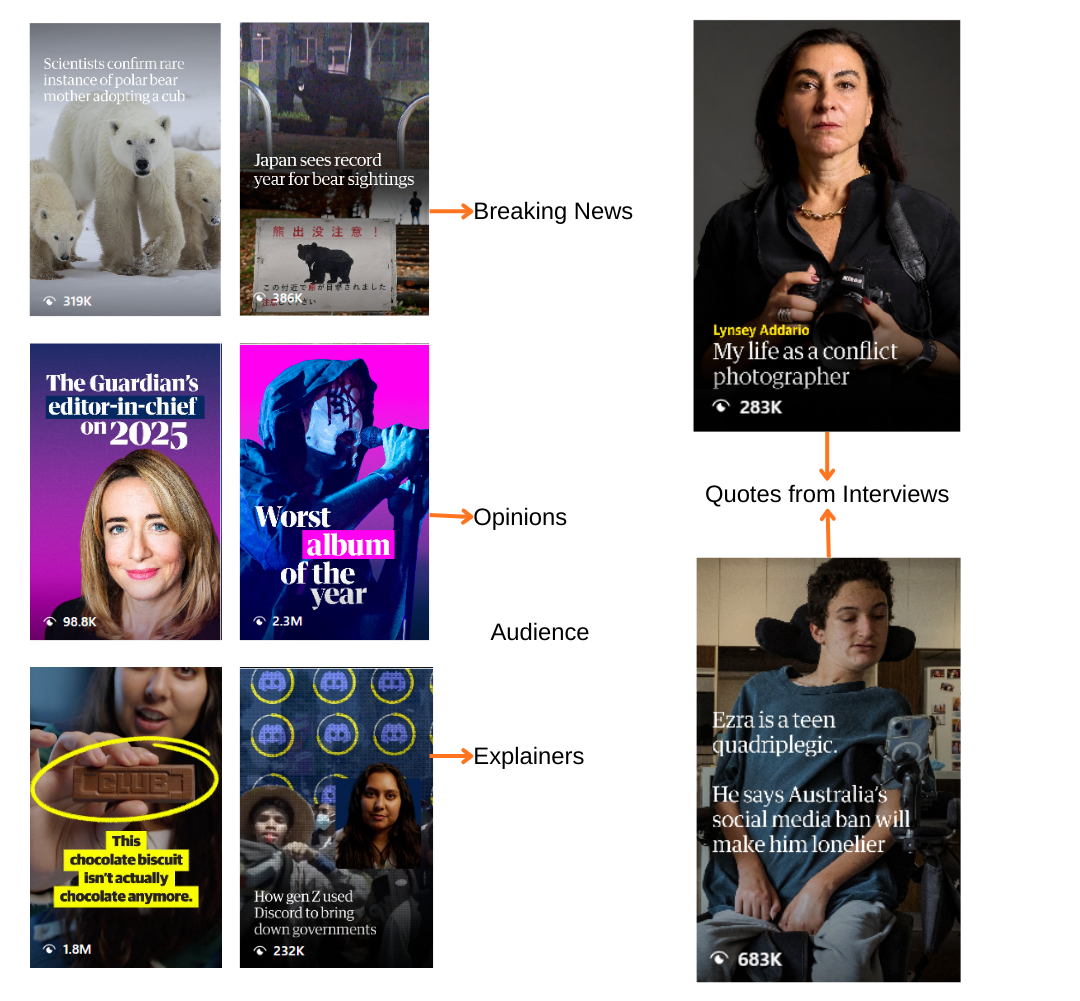
For instance, here’s what The Guardian’s content buckets look like on Instagram:
 Just as important, you should also have “negative” content buckets, consisting of content categories that you won’t post:
- Low-impact articles
- Internal announcements no one cares about
- Content that doesn’t fit the platform
Start by defining 4-6 content categories, assign a purpose to each one, and be ruthless about the content that you don’t want your brand to be associated with.
Together, these 2 constraints should help you put only the best platform-specific content out there,WHILE gaining your audience’s trust.
Pro tip: Build content buckets around your editorial advantages. Make it harder for competitors to copy your content by basing your content buckets on what you can explain better than others and the unique context you have access to.
Step 4: Build a realistic posting schedule you can stick to
Consistency beats frequency. Every time.
Posting daily for 2 weeks and then disappearing for a month does more harm than good, because algorithms reward consistency and your audience expects reliability.
To establish a sustainable schedule, start by deciding your posting frequency for each platform, factoring in your team's capacity. Ideally, you should build around recurring slots rather than posting randomly, so your followers know WHEN to expect content.
For instance, here’s a sample posting schedule you could adopt:
- 1-2 posts per day on high-volume platforms like Instagram and Facebook
- 3-5 posts per week on slower channels like YouTube
- Clear themes for specific days
DON’T make the mistake of choosing an overly ambitious cadence that leads to missed posts and last-minute scrambling.
Step 5: Create a system for finding, planning, and reusing content
As a publisher, you probably already have a deep, underused content library that’s rarely used for social media content.
Since social platforms LOVE creators who post consistently, you can use underused content to come up with new posts.
You can even publish the same post multiple times, either with a different hook, a different takeaway, or in a different format.
An article that first appeared as an X post can later be republished as an Instagram Reel, a carousel, or a short video explainer. Evergreen pieces can resurface every few months without losing relevance.
It’s all fair game.
Here’s how you can create a system that ensures your calendar is always full:
- Plan content in batches
- Turn articles into multiple post formats (image posts, Reels, text posts, etc.)
- Reuse evergreen content intentionally
- Keep a rolling queue of ready-to-post content
Your content should have multiple angles by default (context, implications, data points, quotes, and takeaways) that can fuel days or weeks of social content.
Step 6: Track performance and double down on what works
Social media platforms are constantly changing, so if your strategy isn’t evolving with real data, you’re falling behind.
Take a close look at your winners, and do more of it. Take a close look at your underperformers and do less of it.
Publishers should track these core metrics:
- Engagement rate (Likes, comments, shares, saves)
- Reach and impressions
- Click-through rate (for traffic-focused posts)
- Follower growth over time
- Top-performing content by format and topic
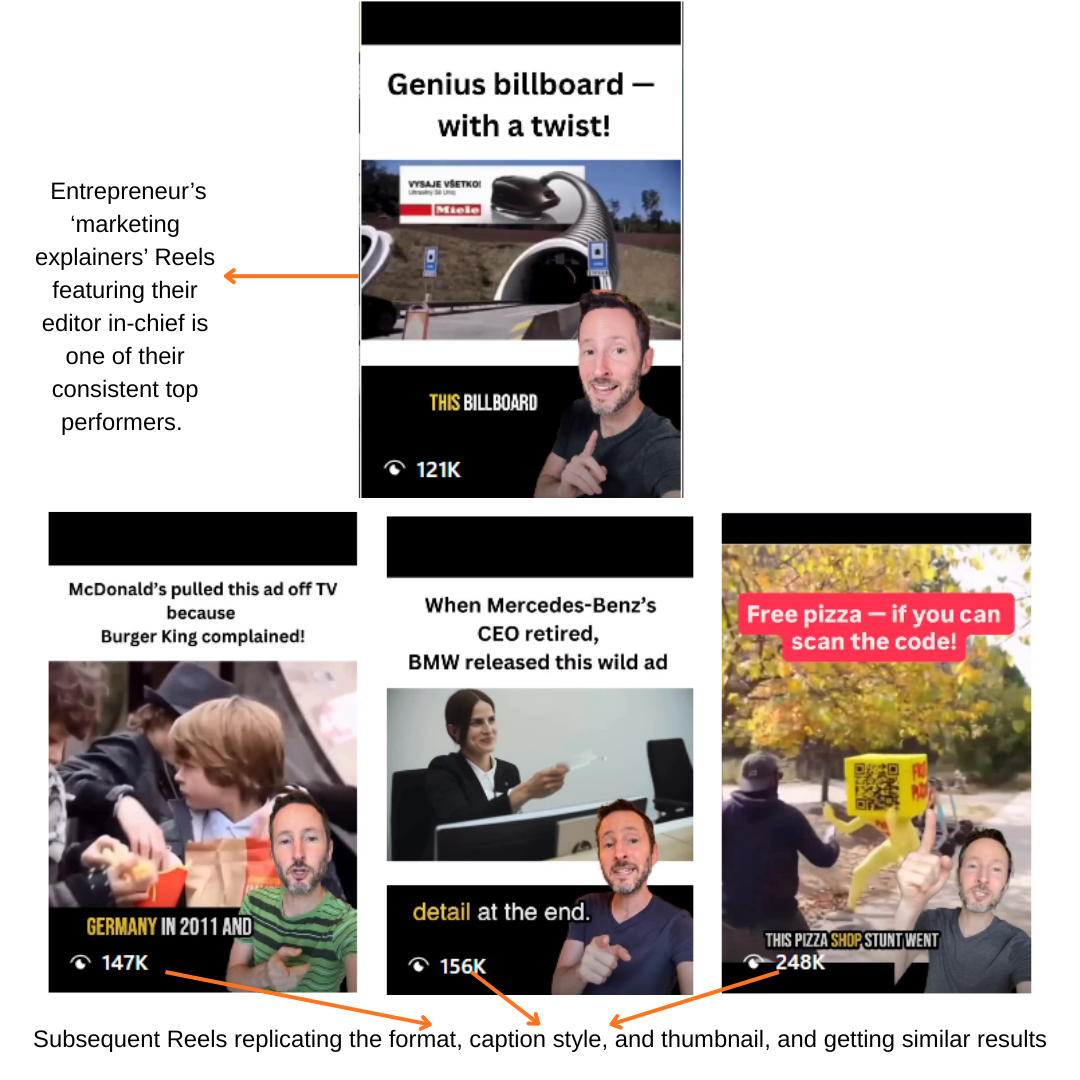
Optimize for repeatable signals. These include posts that received the most saves, drove predictable clicks, and formats that performed even on the slowest news days. It’s easier to build systems around these repeatable signals than to chase outliers. Here’s how Entrepreneur did it:
Best social media platforms for publishers to increase audience engagement
Not every platform is built for publishers. The right platform is the one where:
- Your audience already shows up
- Your content format feels natural
- Engagement compounds over time
In this section, I’ll break down which social media platforms make the most sense for publishers in 2026 and how to use each one without spreading yourself thin.
Facebook remains one of the strongest platforms for discussion-driven engagement, community building, and repeat exposure for loyal readers.
Despite the “Facebook is dead” narrative, Facebook remains a major news source, with 38% of American adults consuming news on Facebook.
Links added to posts are the most popular content type on Facebook at 38.9%, and they’re also among the most common content formats for publications.

To make the most of Facebook:
- Optimize for comments and shares — Facebook’s algorithm prioritizes comment threads, meaningful interactions, and share velocity, which means a post that sparks discussion will usually outperform a post that simply provides a link. You can prime your posts for higher engagement by ending them with a question, a strong opinion, or a contrasting perspective.
- Use link posts strategically — Alternate between native text posts with context, link-based posts, and image/video posts that summarize the story. Native content would warm up your audience, allowing your links to perform better once context has been established.
- Cadence matters less than consistency — A sustainable Facebook posting schedule for publishers getting started can be 1-3 high-quality posts per day. You can use a Facebook scheduling tool like Post Planner to make sure you stick to it.
- Don’t ignore FB Groups for a niche audience — For a defined niche based on geography or industry (like the Wisconsin Rapids Happenings and Local National News), you might see higher engagement in FB Groups. These groups are best suited for contextual follow-ups, discussions, and community-led angles.
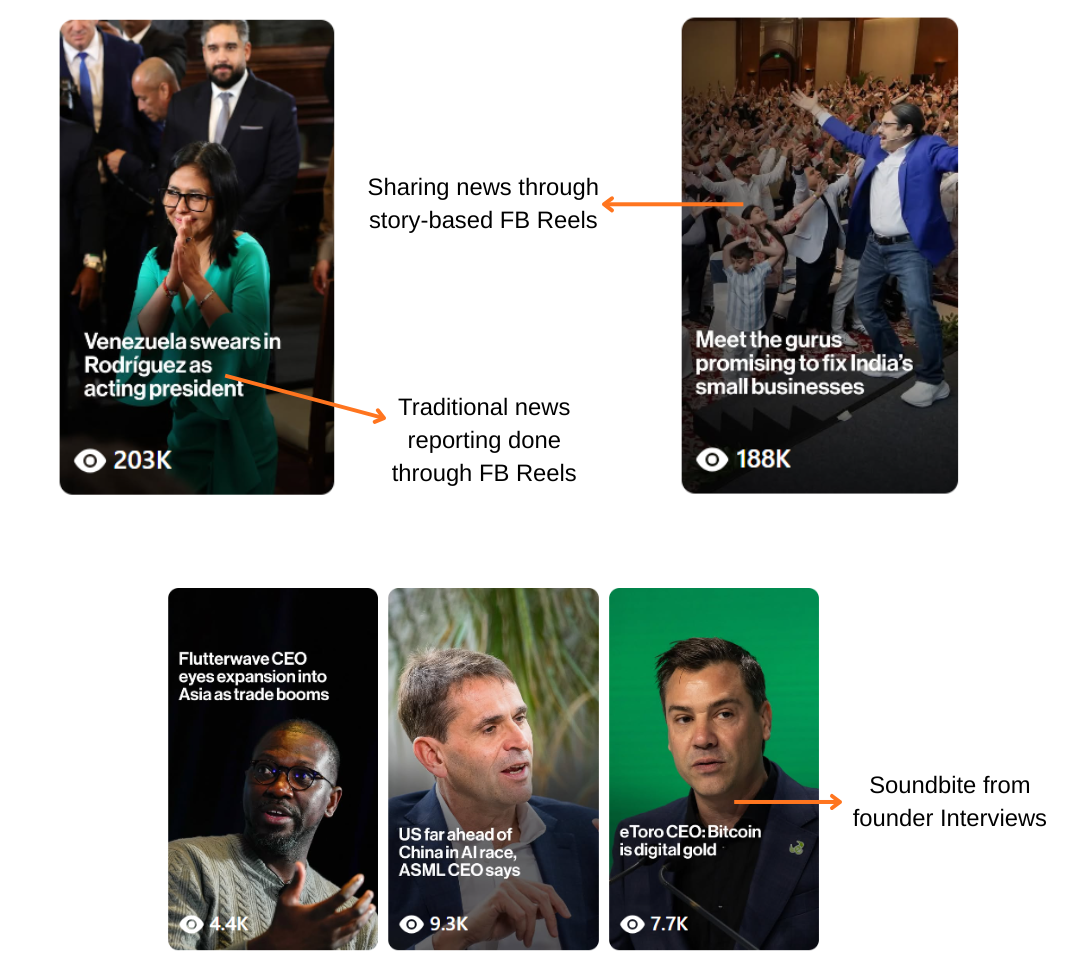
- Experiment with native video — FB Reels tend to give outsized returns when they use a catchy, immediate hook and a clear takeaway within seconds. For example, Bloomberg uses FB Reels to create short clips for the latest news, but it also experiments with story-based Reels and founder interviews.
 Instagram
According to a study by the Association of Magazine Media, Instagram had the highest growth rate among the social networks it tracked over the years, up 24% in magazine followers year over year.
Instagram is a great platform for visual storytelling, humanizing your newsroom or brand, and reaching younger and mobile-first audiences.
To maximize your brand’s Instagram performance:
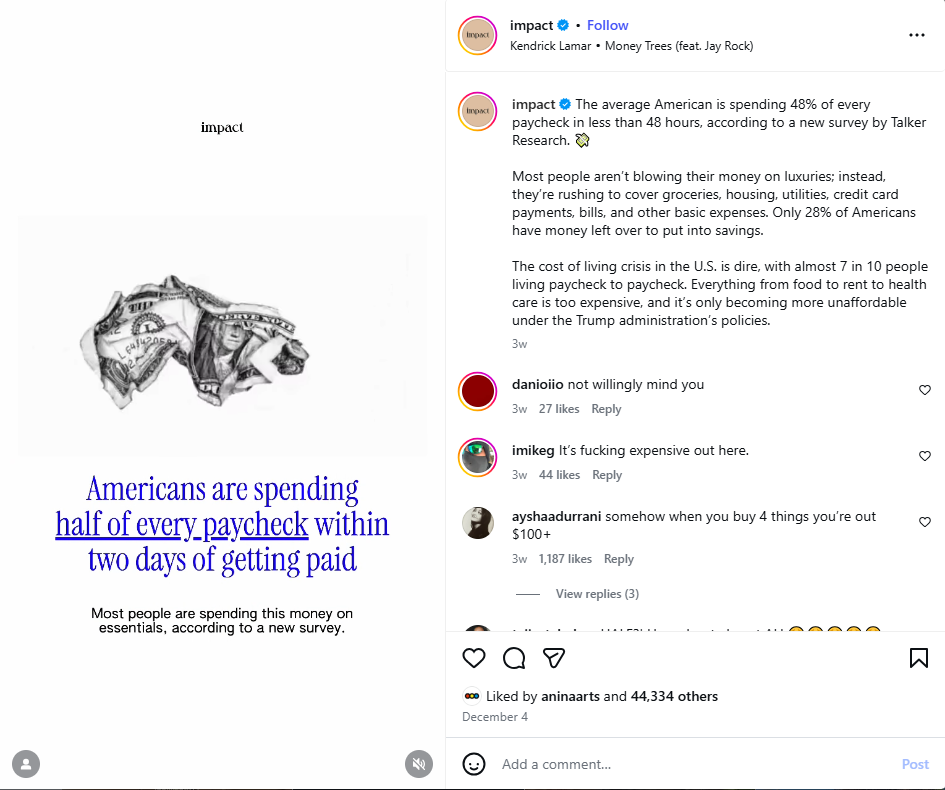
- Treat Instagram as a visual explainer platform — You can do this by turning your news stories into Reels that explain an idea or carousels to break down a concept. For instance, Impact Media posted a GIF as a Reel, with a caption that instantly grabs attention to go with it, which ended up getting 660K views:
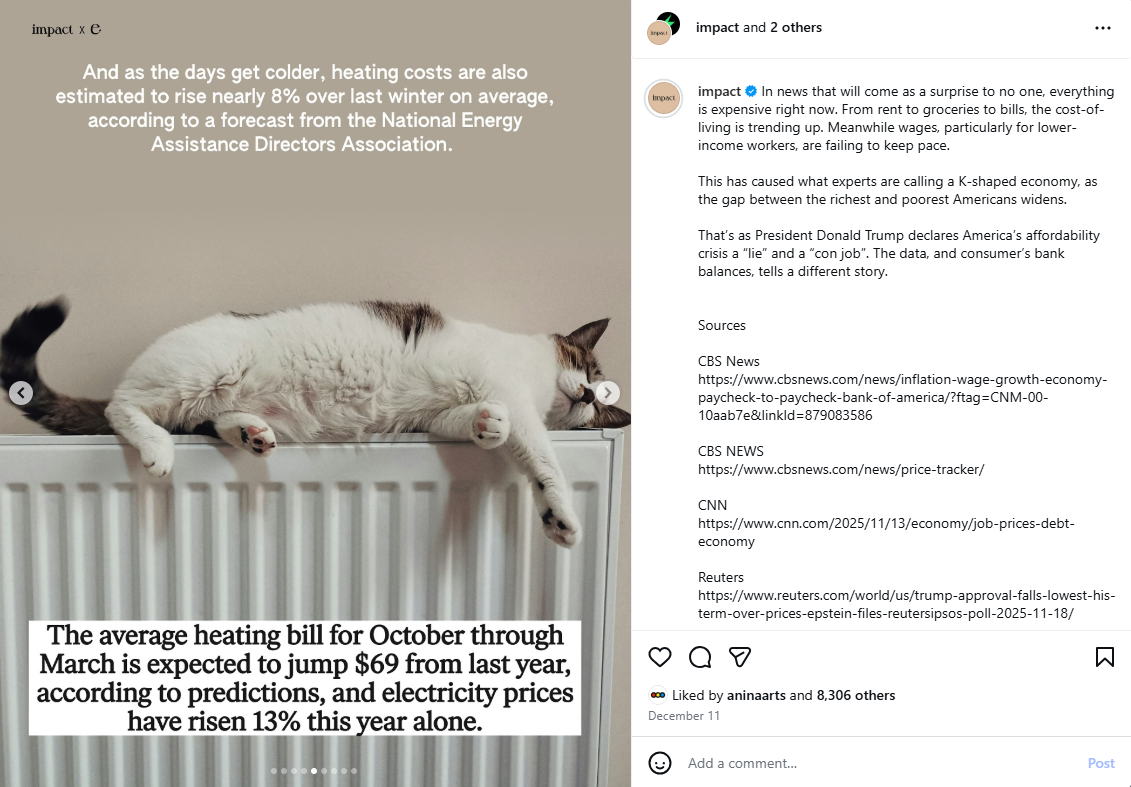
 They also routinely post carousels, such as the one they created on why everything is so expensive, which summarizes findings from other news sources like Reuters, CNN, and CBS News, complete with their unique visuals.
 You can also use IG Stories like The New York Times to provide a story teaser with a catchy title, along with a link to your article for the interested folks.

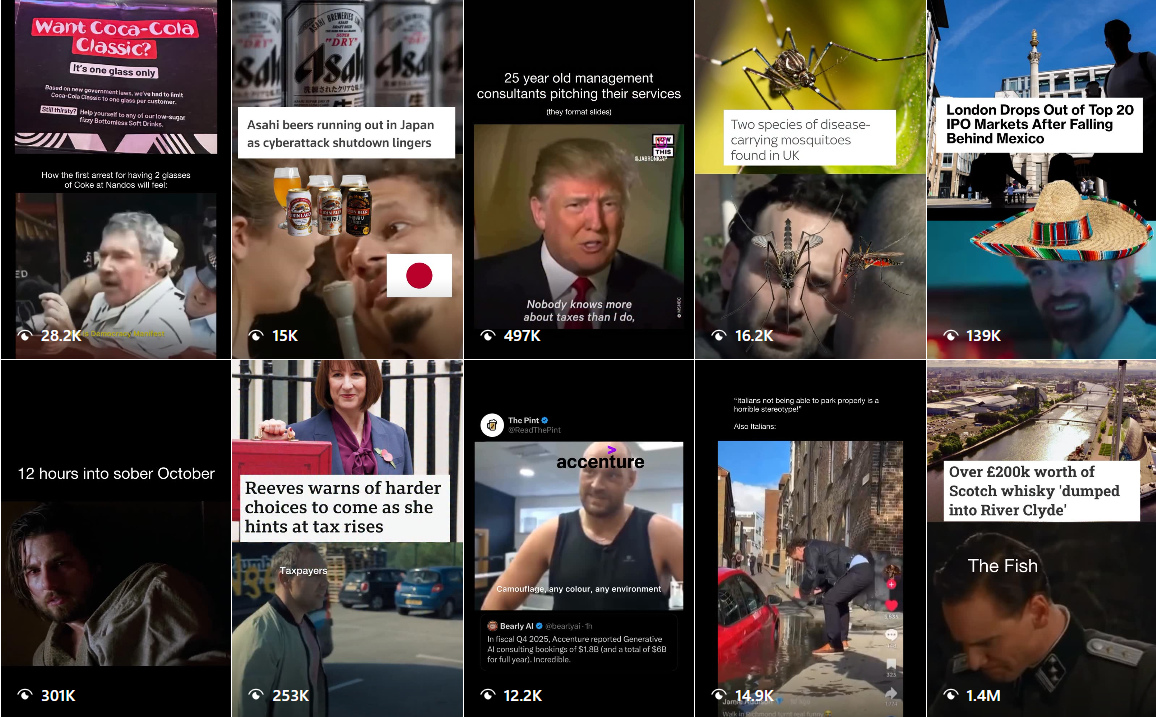
- Prioritize native Reels — Instagram strongly favors vertical video, clear hooks, and captions designed for silent viewing. Morning Brew is a great example of a modern media business that consistently puts out viral content via Reels. Most of their viral stuff tends to be skits parodying real-life occurrences, like their “consultants for consultants” Reel that got 1.2M views and 40K+ likes.
- Design content for shares and saves — The Pint is a newsletter that does this really well. They use meme-based Reels to highlight news stories, with regular users finding their way to their newsletter, where they share a weekly breakdown.
YouTube
As a discovery engine, YouTube offers long-term content value, search-driven discovery, and deeper audience trust to publishers.
According to the Pew Research Center, 35% of American adults consumed news stories on YouTube, making it the most popular channel behind Facebook.
According to Reuters, across the world, 30% of users relied on YouTube for news, with a wide majority paying more attention to traditional news media and journalists than to creators and personalities.
A publication that’s been killing it on YouTube is The Guardian. Here’s what I learned from The Guardian’s YouTube strategy:
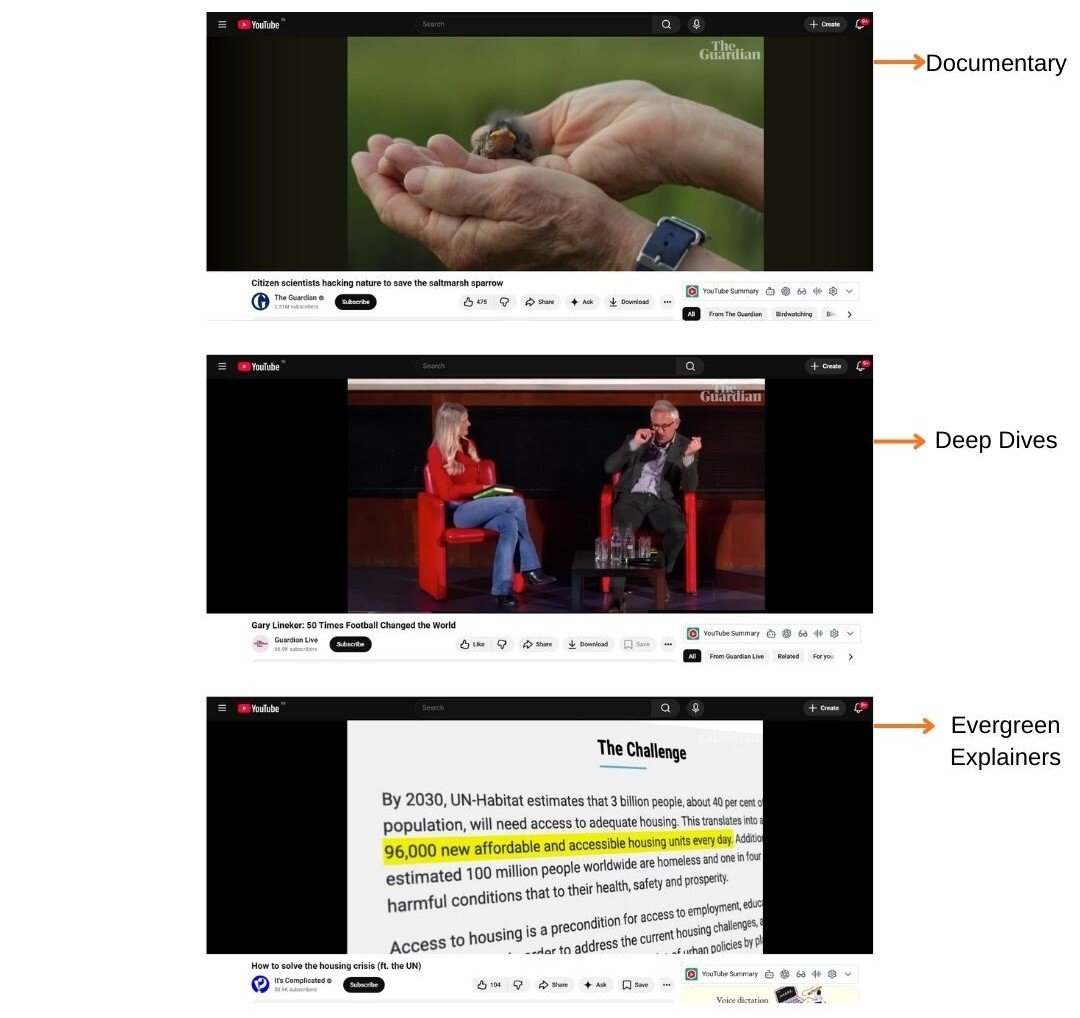
- Treat YouTube as a library — Since YouTube content compounds over time, you should invest in evergreen explainers, deep dives, and documentaries. The Guardian has dedicated YouTube channels covering all of them: The Guardian for documentaries, Guardian Live for deep dives, It’s Complicated for evergreen explainers, and Guardian News for reporting on current events.
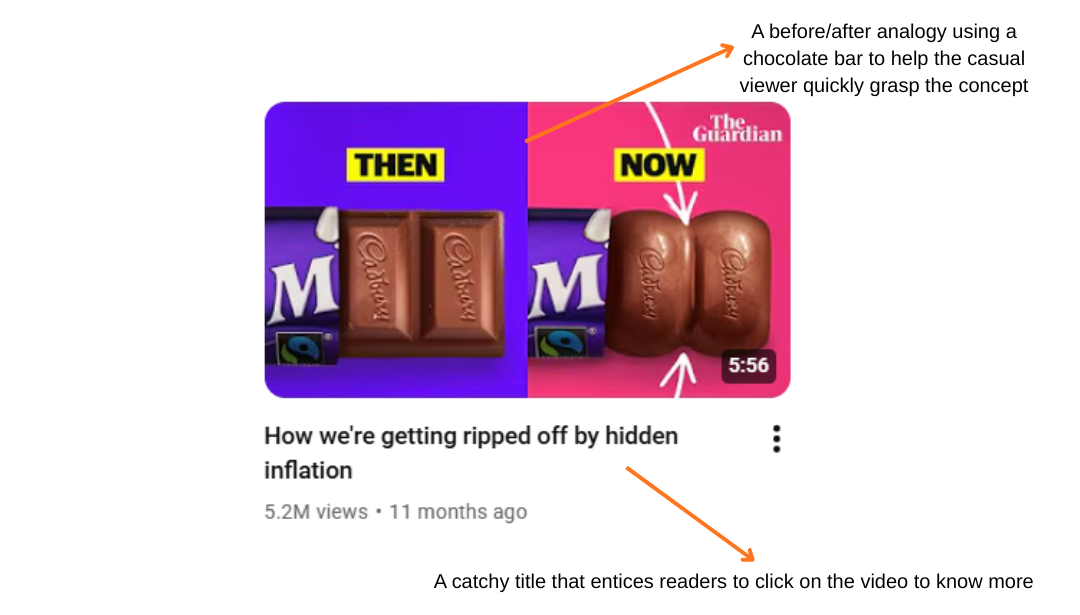
- Thumbnails and titles are editorial decisions — If you look closely, you can see that The Guardian puts a lot of thought into their thumbnails and titles. For instance, here’s a breakdown of one of their most viewed YouTube videos:
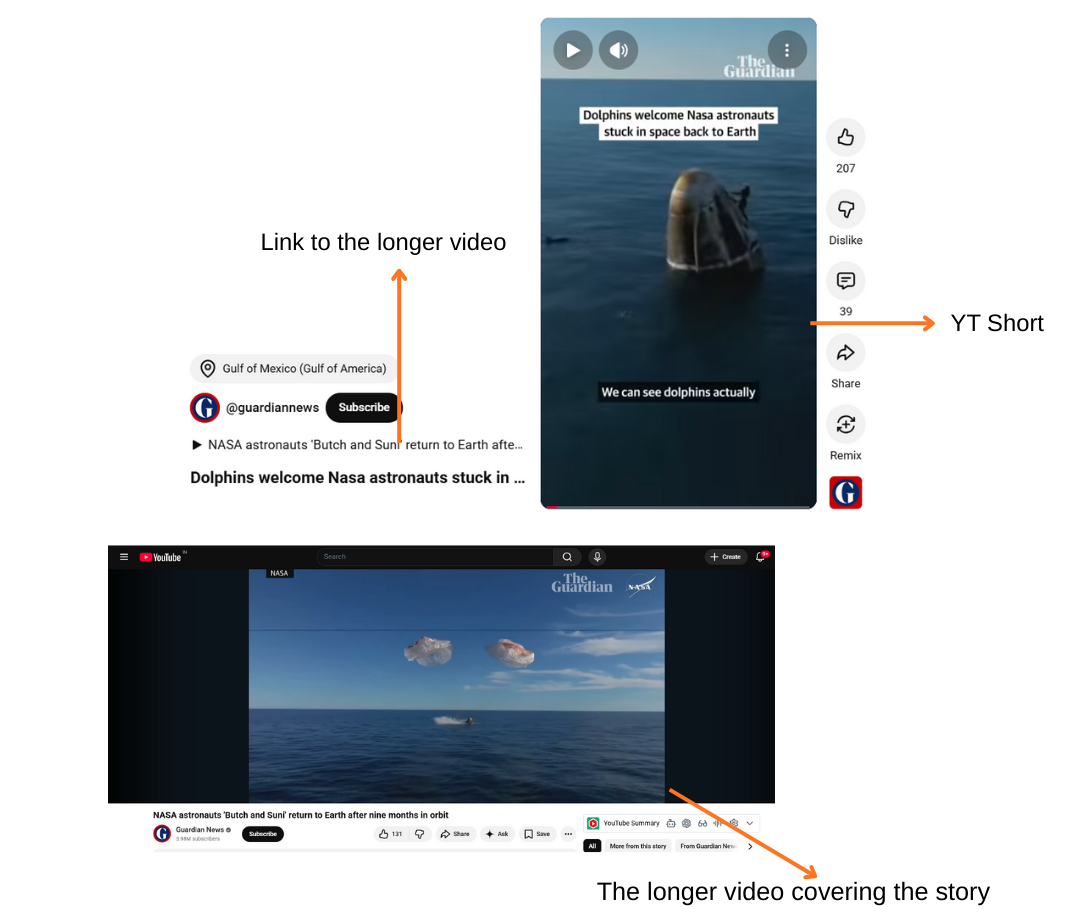
- Shorts should supplement your main videos: For example, when NASA astronauts returned to earth after 9 months in orbit, a group of dolphins flocked to the shuttle. The dolphins became the focal point of the YouTube short, which then linked back to the longer video about the astronauts' return.
TikTok
TikTok is no longer optional if you wanna reach younger audiences. It excels at discovery, storytelling-driven education, and human-first content. Additionally, it ranked 4th among news sources among American users, behind Facebook, YouTube, and Instagram.
Daily Mail, one of the oldest news publishers, has emerged as a trailblazer in the digital journalism space, becoming the most followed news account on TikTok with 25M followers.
Here are a couple of key practices you can implement based on the Daily Mail’s TikTok strategy:
- Treat TikTok as a storytelling engine: TikTok rewards a strong narrative and personality in user videos. Daily Mail’s short-form explainers and their vox pop format (informal street interviews) to capture public sentiment are great examples.
- Avoid newsroom formatting: To succeed on TikTok, you need to provide stories to the audience in the formats they regularly engage with. The Daily Mail frequently publishes content in TikTok native formats, often known as “TikTok edits”, with the use of certain sound effects, voices, and transitions. As a result, the Daily Mail account has become a major hit among younger audiences.
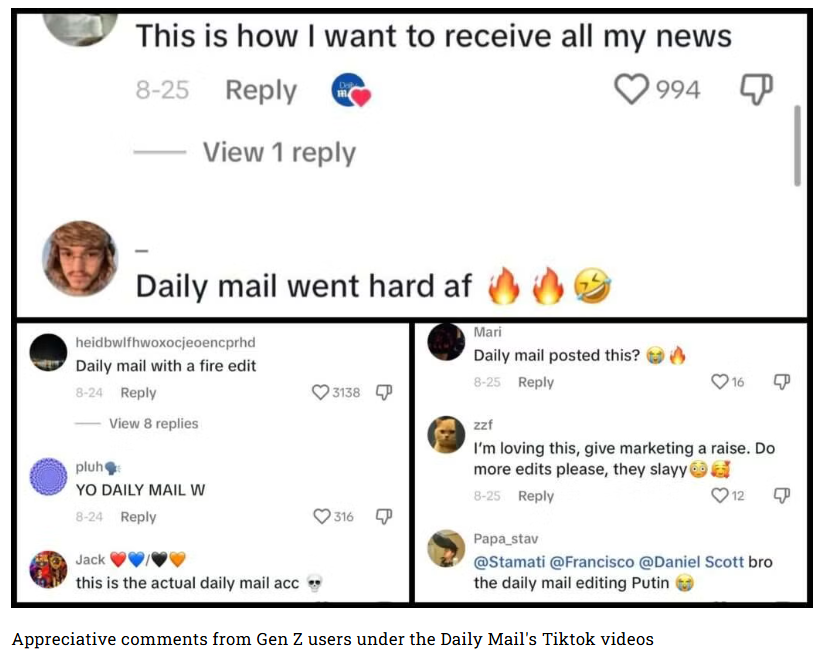 Having team members who understand how the younger generation thinks and engages has been a key driver of their success.
Which is the best platform for you?
Short version: There’s no universal answer. Publishers should choose platforms based on:
- Where your audience already engages
- What content formats you can produce consistently
- How much interaction your team can realistically support
- Whether the platform aligns with your primary goal (engagement, reach, loyalty,traffic, etc.)
Based on the kinda win you’re optimizing for, here’s a table to help you understand which platforms you should start with today:
|
Platform |
Best For |
What Publishers Win |
Key Tradeoff |
Overall Verdict |
|
TikTok |
Audience growth & discovery |
Fast reach, non-follower exposure, cultural relevance |
Weak monetization, short content lifespan |
Best platform for growth |
|
YouTube |
Long-term value & authority |
Evergreen traffic, strong monetization, depth |
Higher production effort, slower feedback |
Best long-term asset |
|
|
Brand presence & consistency |
Visual storytelling, audience touchpoints, fast reach with Reels |
Limited discovery, link friction |
Supporting channel |
|
|
Legacy reach & distribution |
Existing audience reach, occasional viral spikes, and clicks |
Declining organic reach, pay-to-play |
Traffic-driving channel |
The best advice that I can give you is to focus on winning one platform.
Once you’ve built sufficient traction on your primary channel and have a system in place, you can look to expand to other channels.
3 key social media trends for publishers in 2026
Social media keeps changing at the drop of a hat.
If you’re still chasing formats in 2026, you might be in for a rude shock.
There are no set winners, and the algorithms keep changing, so you should focus your energy on understanding why content spreads.
These 3 trends explain what’s actually changing and how publishers can stay ahead without losing credibility.
Algorithm-first content is replacing follower-first content
Algorithms are increasingly prioritizing watch time, dwell time, saves, shares, replies, and ongoing conversations. A carousel, a Reel, a thread, or a post only works if it triggers the right behavior.
Publishers can prioritize algorithm-first content by:
- Analyzing top-performing posts and competitors
- Reverse-engineering why content spreads
- Designing hooks, pacing, and framing to drive retention
If you understand distribution, you can win on any format.
Community-led platforms are driving deeper engagement
As organic distribution becomes more volatile, publishers are shifting their focus from views to conversations, as these signals stronger trust, greater relevance, and longer-term audience value.
As audience engagement shifts from passive consumption to active participation, platforms that center discussion through comment-heavy feeds, private groups, and forums are where publishers will build real loyalty.
A Facebook Group with 4K members, where ~700-800 people engage in daily conversation, is far more valuable than a Facebook Page with 4M followers that gets 3-4 comments per post.
When you become a part of community conversations, you’ll see that some of the best content ideas come from asking questions about what your community wants.
There’s gold hidden in the community’s answers to those questions. Make sure you keep an eye out for it.
You’re winning when people are talking with you rather than just about you.
Short-form video continues to dominate discovery
Short-form video has become a staple discovery channel, right behind search engines.
It’s still the fastest way for new audiences to discover publishers, especially younger ones. They can reach these audiences by using explainers, visual storytelling, and context-first breakdowns to stop the scroll.
Don’t forget that 6 in 10 Gen Z consumers find long-form content through short-form clips, making these bite-sized vids the gateway to deeper audience relationships.
A simple format that highlights 1 idea per video is more than enough to keep your audience engaged. Add some text overlays for clarity, and you’re good to go.
Publishers who win in 2026 will be those who translate their expertise into native formats to boost discoverability.
Best social media marketing tips for publishers
It’s time for the secret sauce!
Here are some pro tips to help you stick with your social media strategy over the long term:
Design posts for engagement, not perfection
Your most polished posts can fail miserably.
In fact, overly polished posts often underperform, especially on feeds built around speed, conversation, and relevance.
Since social algorithms prioritize interaction and engagement over aesthetics, you should prioritize:
- Clarity
- Leading with the takeaway
- Using simple visuals, quotes, or text-first posts
- Writing like an ACTUAL human.
When you optimize for scroll-stopping content that prompts people to react and share it with their friends, you’ll start seeing outsized returns.
Reuse your best-performing content on purpose
Most publishers treat social posts as disposable.
Post it once. Move on. Forget it.
That’s a HUGE waste.
Today, the lifespan of social media posts spans a few hours to a couple of minutes. On platforms like Instagram, you might as well forget the last Reel after you swipe away.
If you look closely, the short attention span has a hidden advantage.
If people forget your content within a few minutes, hours, or days, it means reposting it won’t feel repetitive to your audience.
So, if a post already performed well once, you know that it earned that stamp of approval from your audience, which means you can expect close to similar results when you republish your previous hits.
Algorithms don’t punish repetition either, so reusing and repurposing content should be a key element of your social media strategy.
Here’s what that’d look like in action:
- Identify top-performing posts monthly.
- Repost them with a new hook or angle.
- Turn one strong post into multiple variations (a YouTube video can be turned into an image-based meme on Facebook and short clips to be used on Instagram, TikTok, and Facebook).
- Resurface evergreen stories when relevant again.
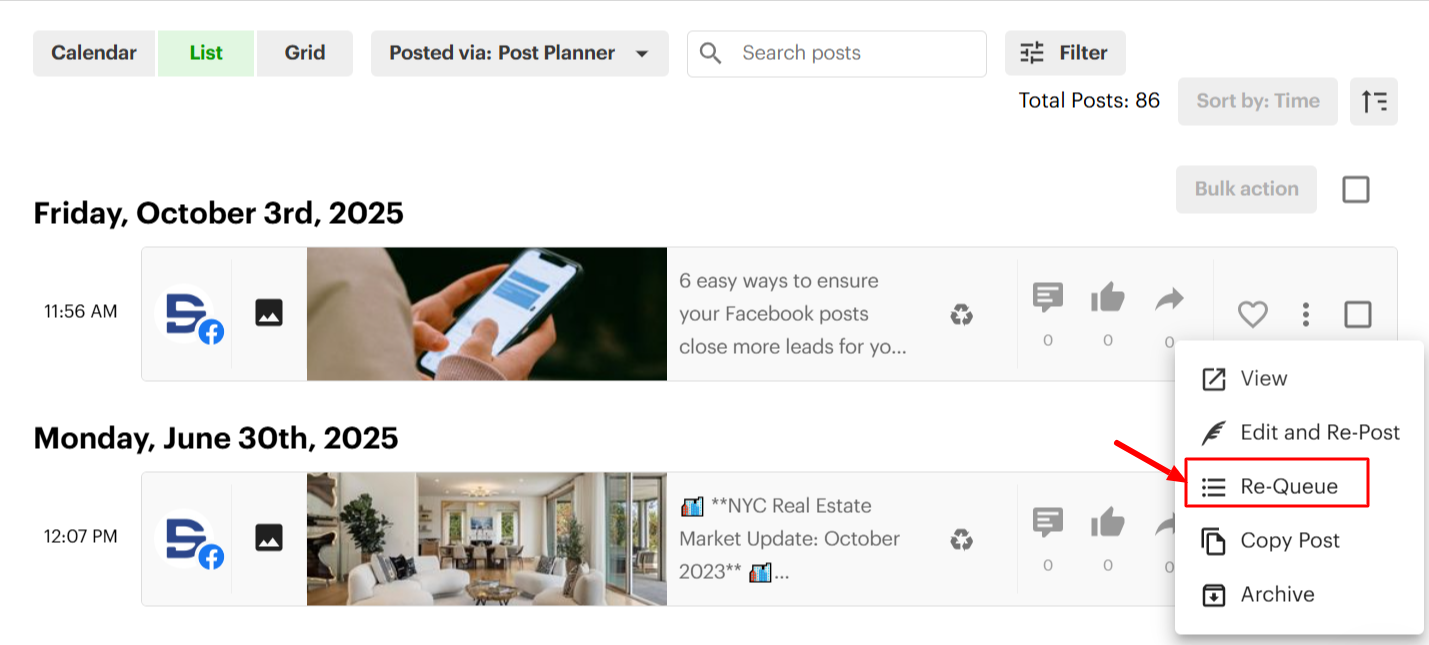
Here’s how you can do this in Post Planner:
- Step 1: On the left-hand sidebar, under “Home,” click on Analyze Posts > Sort by Post Performance.
- Step 2: To see your top-performing posts, choose a time period and sort by Likes, shares, etc. You can re-add posts to your queue one at a time or in bulk.
Batch your work to save time and stay consistent
Daily posting decisions could kill consistency, the one thing that every social media platform rewards.
Instead of starting every post on a blank page, batch your work by planning posts (weekly or monthly), writing multiple captions at a time, and scheduling content in advance using social media scheduling tools like Post Planner.
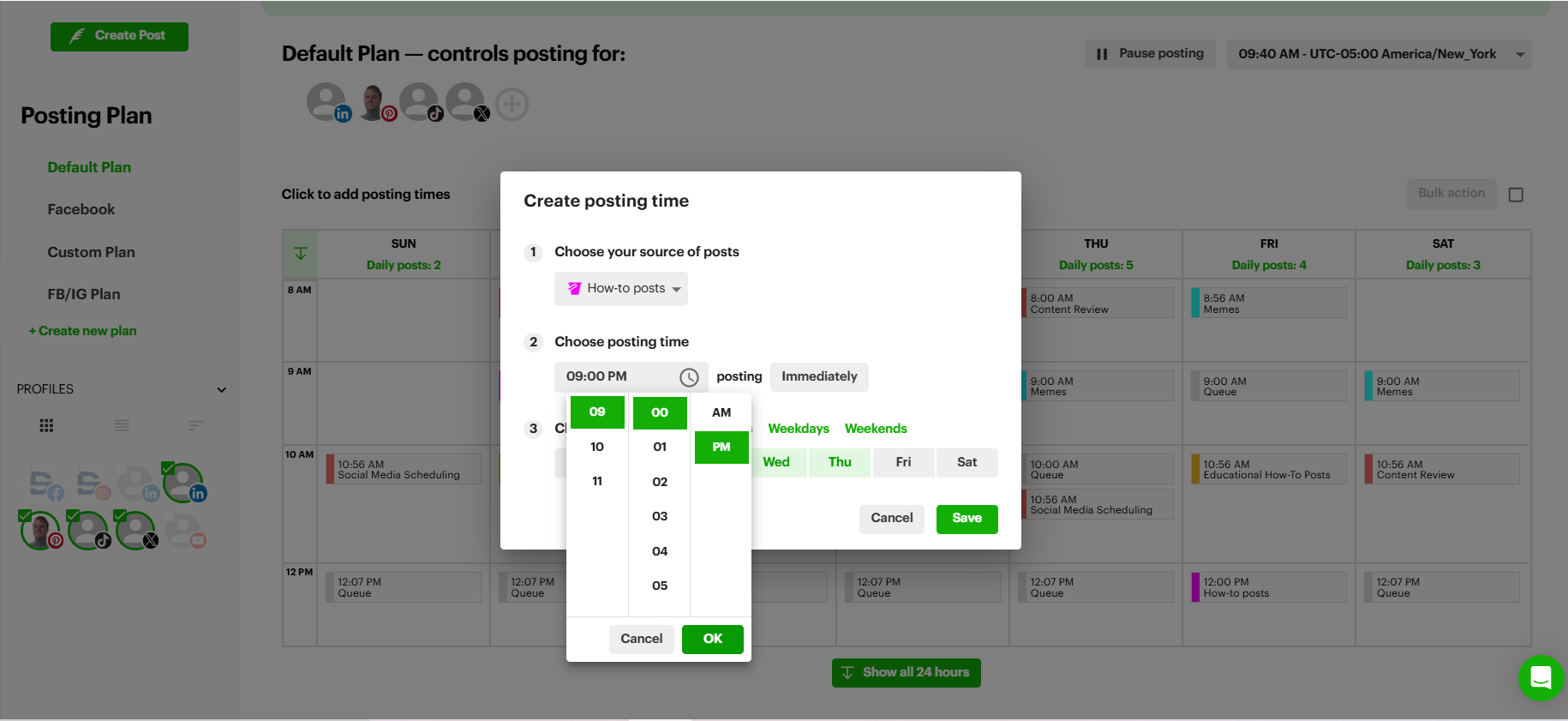 With Post Planner, you can easily schedule weeks of content in bulk, recycle top-performing content, curate top-performing content from across your niche and industry, and tailor every post for each platform.
That’s how you turn social from a daily slog into a predictable workflow.
Ready to build the social strategy for your media company?
Publishers usually lose on social because their strategy isn’t easy enough to follow for the long run.
To win in 2026, focus on keeping it simple.
Publishers can keep it simple by focusing on engagement patterns, robust systems, and reusing winning posts.
Looking for an all-in-one social media management tool for 2026? Try Post Planner for free today to start planning and automating your social media posting!








No Comments